


Navigating DNC Dispute Resolution (DRS)
The Domain Name Commission Dispute Resolution Service (DRS) is an alternative to court litigation designed to resolve disputes regarding .nz domain names. It allows rights holders to challenge registrations based on “unfair registration” criteria, utilizing a structured process of informal mediation and expert determination to ensure intellectual property rights are respected within the New Zealand namespace.
What is the DNC Dispute Resolution Service?
The New Zealand domain market operates under a unique set of governance protocols managed by the Domain Name Commission (DNC). Unlike the Uniform Domain-Name Dispute-Resolution Policy (UDRP) which governs generic top-level domains like .com or .net, the .nz namespace utilizes its own specific policy known as the Dispute Resolution Service (DRS).
For businesses operating in New Zealand, the integrity of a .co.nz or .nz web address is often the cornerstone of their digital identity. When a third party registers a domain that infringes upon a brand’s trademark or goodwill, the DRS provides a mechanism to recover that asset without the prohibitive costs and extended timelines associated with the High Court.
The DRS is fundamentally designed to be accessible. While legal representation is permitted, the system is streamlined enough that individuals and business owners can navigate it directly. The primary objective is to determine whether a domain name was registered or is being used in a manner that is unfair to the Complainant, who must hold rights in a name or mark that is identical or similar to the domain in question.
Grounds for a Dispute: Defining Unfair Registration
To succeed in a domain name commission dispute resolution case, a Complainant must satisfy a two-limbed test. It is not enough to simply own a trademark; one must prove that the current registrant holds the domain unfairly. The burden of proof lies with the Complainant to demonstrate both of the following on the balance of probabilities:
1. Rights in the Name
The Complainant must prove they have rights in a name or mark that is identical or confusingly similar to the domain name. These rights can be:
- Registered Trademarks: A trademark registered with the Intellectual Property Office of New Zealand (IPONZ).
- Unregistered Rights (Common Law): Goodwill and reputation established through commercial use of the name in New Zealand.
2. Unfair Registration
This is the most complex aspect of the dispute. The DNC policy provides a non-exhaustive list of what constitutes an unfair registration. A registration is likely to be considered unfair if the domain name:
- Was registered primarily for the purpose of selling, renting, or transferring it to the Complainant for a profit (excessive consideration).
- Was registered to block the Complainant from registering a name in which they have rights.
- Was registered to unfairly disrupt the business of the Complainant.
- Is being used in a way that is likely to confuse, mislead, or deceive people into believing it is connected to the Complainant.
It is important to note that unlike the UDRP, which requires proving “bad faith” registration and use, the NZ DRS focuses on “unfair registration.” This is a subtle but significant distinction that can lower the barrier for Complainants in certain scenarios.

The DRS Process: Timeline, Steps, and Costs
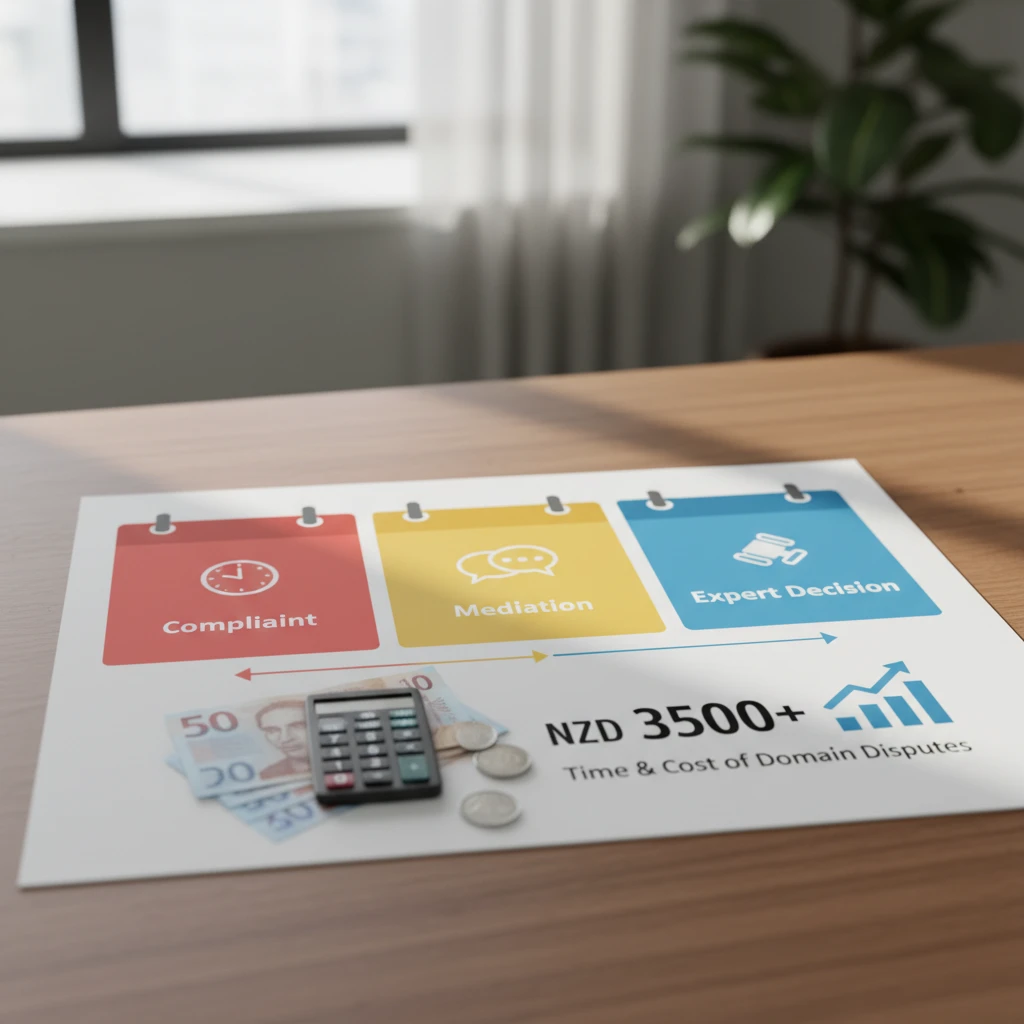
Navigating the DRS requires strict adherence to procedural timelines. Missing a deadline can result in the dismissal of a complaint or a default decision against a respondent. Below is the standard workflow for a dispute.
Step 1: The Complaint and Response
The process initiates when the Complainant files a formal dispute via the DNC’s online platform. The complaint must detail the rights held and the evidence of unfair registration. Once validated by the DNC, the Respondent (the current domain holder) has 25 working days to submit a response. If they fail to respond, the Complainant can request a summary decision.
Step 2: Informal Mediation
If a response is filed, the process moves to Informal Mediation. This is a mandatory step (unless opted out by the Complainant, though rare) where a neutral mediator appointed by the DNC attempts to help both parties reach a mutually agreeable settlement. This phase is free of charge and confidential. Mediation typically lasts up to 10 working days but can be extended if a settlement appears imminent.
Step 3: Expert Determination
If mediation fails, the Complainant has the option to pay for an Expert Determination. This is where the costs are incurred. The Complainant must pay the fee (typically around $2,000 NZD + GST for a single panelist) to have an independent expert review the case and make a binding decision. The expert will decide whether to transfer the domain, cancel it, or dismiss the complaint.
Step 4: Appeal
Either party can appeal the Expert’s decision within a specific timeframe, though this incurs significantly higher fees (often upwards of $7,200 NZD) as it involves a panel of three experts.
The Critical Role of Informal Mediation
One of the most effective features of the NZ DRS is the emphasis on mediation. Statistics from the Domain Name Commission suggest that a significant percentage of disputes are resolved at this stage. This is highly beneficial for both parties.
For the Complainant, mediation offers a faster resolution without the cost of Expert Determination. For the Respondent, it offers a chance to negotiate an exit without a public adverse finding against them. In the context of domain brokerage, mediation is often where deals are struck. A squatter may realize their legal position is weak and agree to transfer the domain for a nominal fee (often labeled as ‘expenses’) rather than face a total loss.
Expert Determination: When Mediation Fails
When parties cannot agree, the independent expert takes over. The expert does not hold a hearing; the decision is made solely based on the written submissions. This underscores the importance of a comprehensive initial complaint.
The expert is looking for concrete evidence. Assertions without proof are generally disregarded. If you claim the Respondent registered the domain to sell it to you, provide the email chain where they demanded an exorbitant price. If you claim confusion, provide analytics or customer affidavits showing they went to the wrong site.
Case Studies: Successful Recovery of .co.nz Domains
Understanding the theory is helpful, but examining how the policy is applied in practice provides the best insight into domain name commission dispute resolution.
Case Study A: The Opportunistic Reseller
Scenario: A local New Zealand plumbing company, “KiwiPlumb,” forgot to renew their secondary domain, kiwiplumb.nz. A domain reseller immediately snapped it up and put up a parking page with pay-per-click ads for rival plumbing services.
The Dispute: KiwiPlumb filed a DRS complaint. They proved they had traded as KiwiPlumb for 10 years (Common Law rights). They argued the registration was unfair because the Respondent had no connection to the name and was using it to disrupt KiwiPlumb’s business by diverting customers to competitors via ads.
Outcome: The Expert ruled in favor of KiwiPlumb. The use of the domain for PPC ads related to the Complainant’s specific industry is a classic example of unfair use.
Case Study B: The Disgruntled Ex-Employee
Scenario: An IT manager left a firm on bad terms. He registered companyname-scam.co.nz and hosted a gripe site.
The Dispute: The company filed a complaint. While they had rights in the name, the Expert had to weigh the right to freedom of expression against unfair registration.
Outcome: In this specific instance, the complaint was denied. The DNC policy respects genuine criticism. As long as the domain was not used for commercial gain and was clearly a criticism site (not misleading users into thinking it was the official site), it was not deemed “unfair” under the policy, despite being damaging to the company.

Strategic Tips for Filing a Complaint
If you find yourself needing to utilize the DRS, preparation is paramount. As a market expert in NZ domain brokerage, I recommend the following strategy:
1. Secure Evidence Before Alerting the Registrant
Before you send a cease and desist letter, capture everything. Take screenshots of the website, the Whois records, and any marketplace listings. If the content on the site changes after you contact them, you will need proof of how it looked previously.
2. Check for “Pattern of Conduct”
Use domain tools to see if the Respondent owns other domains that infringe on trademarks. Establishing that the Respondent is a serial cybersquatter significantly strengthens your argument for unfair registration.
3. Don’t Ignore the “Without Prejudice” Rule
During mediation, discussions are “without prejudice,” meaning they cannot be used as evidence in the Expert Determination phase. However, pre-dispute correspondence is usually admissible. If the Respondent emailed you asking for $5,000 for a $25 domain, that is gold dust for your case.
People Also Ask
How much does a domain dispute cost in NZ?
Filing a complaint is free. Mediation is also free. However, if the case proceeds to Expert Determination, the Complainant must pay a fee, typically $2,000 NZD plus GST. If an appeal is lodged, fees can exceed $7,000.
Can I handle a DNC dispute without a lawyer?
Yes, the DNC DRS is designed to be accessible to laypeople. However, the concepts of “rights” and “unfair registration” are legal in nature. If the domain is of high value to your business, consulting a domain strategist or IP lawyer is recommended.
What is the difference between UDRP and DRS?
The UDRP applies to gTLDs like .com and requires proving “bad faith” registration AND use. The NZ DRS applies to .nz domains and requires proving “unfair registration,” which is generally considered a broader and slightly easier threshold for Complainants to meet.
How long does the DNC dispute process take?
The entire process typically takes between 60 to 90 days. This includes the response period (25 days), mediation (10-20 days), and the time required for the Expert to write their decision.
What happens if the respondent doesn’t reply?
If the Respondent fails to reply within 25 working days, the Complainant can request a decision based on the complaint alone. This usually results in a faster transfer of the domain, provided the complaint establishes a prima facie case.
Can I appeal a DNC decision?
Yes, either party can appeal the decision of an Expert. An appeal panel consists of three experts. The appeal must be filed within a short window after the initial decision, and substantial fees apply.
