

Recovering Lost Corporate Domains
To recover an expired domain in NZ, immediately contact your registrar within the 90-day grace period to pay renewal and reactivation fees. If the domain has fully dropped and been re-registered by a third party, you must either negotiate a buy-back through a domain broker or file a Dispute Resolution Service (DRS) claim with the Domain Name Commission if you hold trademark rights.
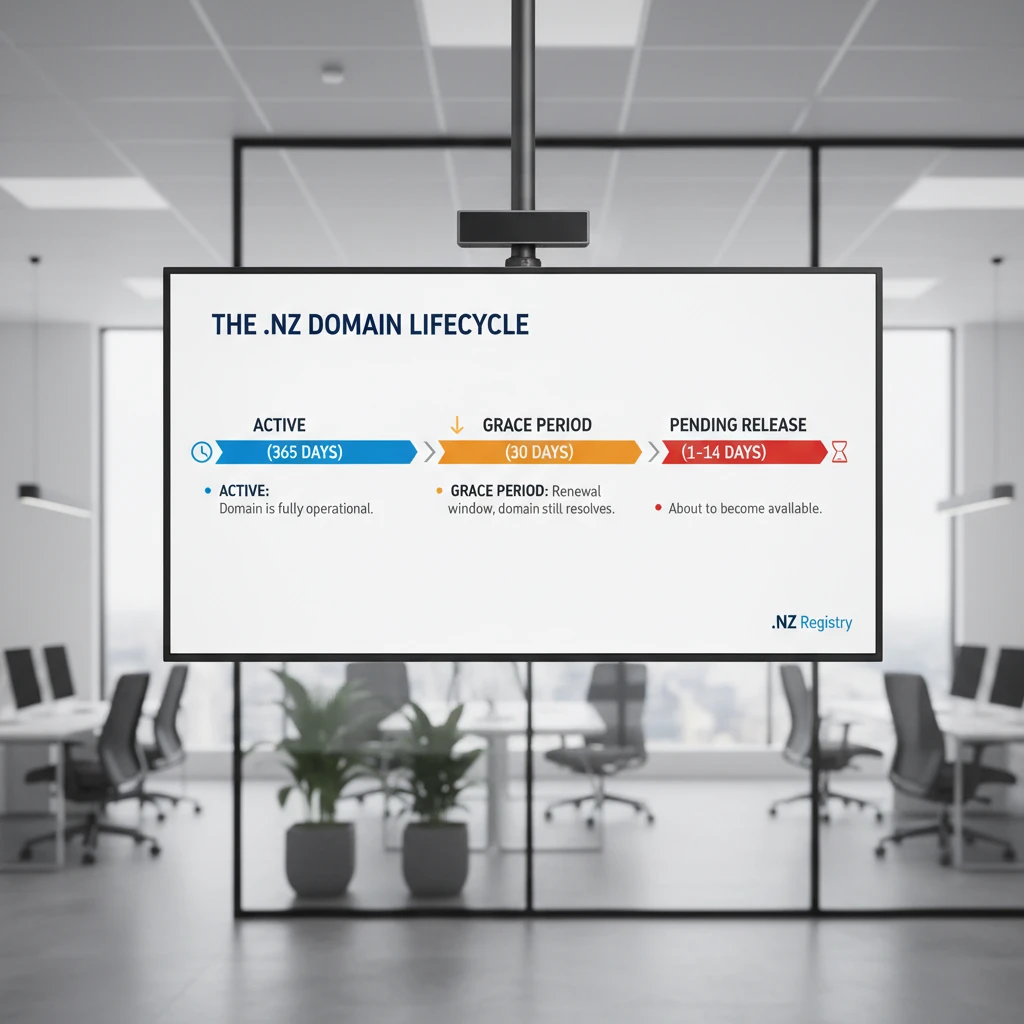
Immediate Steps: The .nz Domain Lifecycle
For a corporate entity, losing a domain name is akin to losing the keys to the office. It halts email communication, breaks customer trust, and disrupts revenue streams. If you are reading this, time is likely of the essence. The strategy to recover expired domain nz assets depends entirely on where the domain currently sits within the lifecycle defined by InternetNZ and the Domain Name Commission (DNC).
In New Zealand, the domain lifecycle is strictly regulated. Unlike generic top-level domains (gTLDs) like .com which have complex redemption periods, the .nz space operates on a specific timeline that offers registrants a window of opportunity before the asset is lost to the open market.
How to Check Your Domain Status
Before taking action, use the WHOIS lookup tool provided by the Domain Name Commission (dnc.org.nz). You are looking for one of the following statuses:
- Active/Grace Period: The domain has expired but is still held by the registrar. Recovery is simple and immediate upon payment.
- PendingRelease: The domain is in its final days before being dropped. Immediate action is critical.
- Available: The domain has dropped and can be registered by anyone.
- Registered (to someone else): The domain has been lost and acquired by a third party.
Understanding the Redemption Grace Period
The “Redemption Grace Period” is your safety net. In the context of the .nz registry, this is often referred to simply as the renewal grace period. Once a domain passes its expiry date, it does not immediately vanish from your ownership.
The 90-Day Safety Net
Typically, .nz domains enter a grace period that lasts for 90 days following the expiry date. During this time, the domain will likely cease to function—your website will go offline, and emails will bounce—but the registration record remains linked to your account.
During this phase, the domain is not available to the public. No “drop catcher” or competitor can register it. However, your registrar (the company you bought the domain from) has the right to cancel the domain sooner if their terms of service specify a shorter window, though 90 days is the standard registry max.
Costs Associated with Late Renewal
Recovering a domain becomes progressively more expensive the longer you wait. While a standard renewal might cost between $25 and $50 NZD, letting a domain lapse triggers administrative overheads that registrars pass on to the client.
Standard Renewal vs. Reactivation Fees
If you catch the expiration within the first few days or weeks, you will typically only pay the standard renewal fee. However, as the domain moves deeper into the grace period, registrars may apply a “reactivation fee.” This fee covers the manual intervention required to restore DNS settings and remove suspension flags.
The High Cost of “Pending Release”
If the domain has been cancelled and is in the process of being released, some registrars may charge a significant redemption fee to pull it back from the brink of deletion. While .nz fees are generally lower than the expensive redemption fees seen in .com domains (which can reach upwards of $200 USD), corporate registrars often charge premium service fees for emergency recovery.

What to Do If Someone Else Registers Your Dropped Domain
This is the “Code Red” scenario. If the 90-day period lapses and the domain is released, it becomes available to the general public. In the competitive NZ market, valuable corporate domains are often snapped up within milliseconds by automated scripts known as “drop catchers” or “snipers.”
If your domain is now owned by a third party, your options shift from administrative renewal to asset acquisition. You are no longer the registrant; you are a prospective buyer.
Identifying the New Owner
Due to privacy laws, the individual owner’s name might be redacted on the WHOIS lookup. However, there is usually a method of contact, such as an anonymized email alias or a contact form link. Do not contact them immediately using your corporate email. Revealing that a large corporation is desperate to recover the domain will instantly drive the asking price up by thousands of dollars.
Using a Corporate Domain Broker
When a domain is lost to a squatter or a legitimate investor, attempting to recover it yourself is fraught with risk. Emotional attachment and lack of negotiation experience often lead to overpayment.
Why Hire a Broker?
A professional domain broker acts as a buffer between your company and the current registrant. They specialize in the recover expired domain nz process for high-value assets. Their role includes:
- Anonymity: They approach the seller without revealing your brand identity.
- Valuation: They understand the true market value of .nz domains and can prevent price gouging.
- Escrow: They ensure the transaction is secure, holding funds until the domain control is successfully transferred.

Legal Recourse: The Dispute Resolution Service (DRS)
If the current owner is refusing to sell or demanding an extortionate fee, and you believe the registration was made in “bad faith,” you may have legal recourse through the Domain Name Commission’s Dispute Resolution Service (DRS).
Understanding “Unfair Registration”
The NZ DRS is similar to the international UDRP but is specific to New Zealand. To succeed in a dispute, you generally need to prove two things:
- Rights: You have rights (usually trademark rights) in a name which is identical or similar to the domain name.
- Unfair Registration: The registration of the domain name in the hands of the respondent is unfair.
What Constitutes Unfairness?
“Unfairness” in the NZ market usually involves evidence that the registrant acquired the domain primarily to sell it to you for a profit (cybersquatting), to block you from registering it, or to confuse customers into thinking the website is affiliated with your business.
The DRS process is faster and cheaper than High Court litigation. It involves filing a complaint, allowing the other party to respond, and having an independent expert make a binding decision. If you win, the domain is transferred back to you.

Future-Proofing Your Corporate Portfolio
Recovering a lost domain is stressful, expensive, and risky. The best strategy is robust prevention. Corporate domain management requires more than a credit card on file.
Consolidate to a Corporate Registrar
Move your domains away from budget, retail registrars. Corporate registrars offer dedicated account managers, auto-renewal guarantees, and protection against accidental deletion. They act as a strategic partner rather than just a vendor.
Implement “Registry Lock”
For mission-critical domains, ask your registrar about Registry Lock services. This adds a layer of verification at the registry level, meaning no changes (including deletion or transfer) can be made without offline authentication. This is the gold standard for protecting against both accidental expiration and malicious hijacking.
By understanding the lifecycle of a .nz domain and knowing when to deploy brokers or legal counsel, businesses can navigate the treacherous waters of domain recovery. Act fast, negotiate smart, and secure your digital borders.
People Also Ask
How long is the redemption period for .nz domains?
The .nz domain lifecycle typically includes a grace period of 90 days after the expiry date. During this time, the domain is suspended but can be renewed by the original registrant. Unlike .com domains, .nz does not have a separate, distinct “Redemption Grace Period” with high fees; it is generally treated as an extended renewal period before the domain is released.
Can I get a domain back after it expires?
Yes, you can get a domain back after it expires if you act within the grace period (usually 90 days for .nz domains). You simply need to pay the renewal fee. If the grace period has ended and the domain has been released to the public, you can only get it back by re-registering it (if available) or buying it from the new owner.
How much does it cost to redeem a domain?
If the domain is still in the grace period, the cost is usually the standard renewal fee ($25-$50 NZD) plus a potential reactivation fee charged by the registrar. If the domain has been lost and you must buy it from a broker or squatter, the cost can range from $500 to tens of thousands of dollars depending on the domain’s commercial value.
What is the Domain Name Commission NZ?
The Domain Name Commission (DNC) is the regulatory body appointed by InternetNZ to manage the .nz domain name space. They handle the regulation of the .nz market, authorize registrars, and manage the Dispute Resolution Service (DRS) for conflicts regarding domain ownership.
How do I find out who owns a .nz domain?
You can find out who owns a .nz domain by using the WHOIS lookup tool on the Domain Name Commission website (dnc.org.nz). Note that for individual registrants, contact details may be withheld for privacy, but a method to contact the owner is usually provided.
What is domain squatting in New Zealand?
Domain squatting, or cybersquatting, is the act of registering a domain name that corresponds to a trademark or business name of another entity with the intent of selling it to them for a profit. In New Zealand, this is considered “Unfair Registration” and can be challenged through the Dispute Resolution Service (DRS).
