


Defensive Registration Strategy
Defensive domain registration NZ is the strategic practice of registering multiple domain name variations, extensions, and misspellings to prevent third parties from capitalizing on a brand’s reputation. This proactive measure safeguards New Zealand businesses against cybersquatting, brand dilution, and phishing attacks, ensuring that digital traffic is funneled exclusively to the legitimate entity.
What is Defensive Domain Registration?
In the digital economy, a domain name is more than just a web address; it is a primary asset of intellectual property. Defensive domain registration involves acquiring domain names that you do not intend to use for a primary website but wish to control to prevent others from using them. This strategy is akin to buying insurance for your brand’s digital identity.
For New Zealand businesses, the digital landscape is governed largely by the “first-come, first-served” principle. While trademark laws offer some protection, the process of reclaiming a domain often involves costly legal battles or arbitration. A defensive registration strategy circumvents these disputes by securing the assets before bad actors can.
The Core Threats: Cybersquatting and Brand Dilution
The primary driver for defensive registration is the mitigation of cybersquatting. Cybersquatters register domain names identical or confusingly similar to existing trademarks with the intent of selling them back to the trademark owner at an inflated price or diverting traffic to competitors. Without a defensive perimeter, your brand is susceptible to:
- Traffic Diversion: Competitors redirecting your potential customers to their sites.
- Phishing Campaigns: Bad actors creating lookalike domains to steal customer credentials.
- Reputation Damage: Domains being used for adult content or gambling sites, tarnishing your brand image.
Why NZ Businesses Are Vulnerable
The New Zealand domain market is unique. While it is a smaller market compared to the global .com space, the trust associated with local domains is incredibly high. Kiwi consumers are conditioned to trust .co.nz and .nz extensions implicitly. If a scammer secures a variation of your domain with a local extension, the likelihood of a local consumer falling victim to a scam is significantly higher than with a generic extension.
Furthermore, the liberalization of the .nz namespace in 2014, which allowed for registration at the second level (e.g., yourbrand.nz directly, rather than yourbrand.co.nz), doubled the attack surface for many businesses. Companies that held the .co.nz but failed to secure the .nz equivalent often found themselves in disputes or forced to pay premiums to acquire the shorter version later.
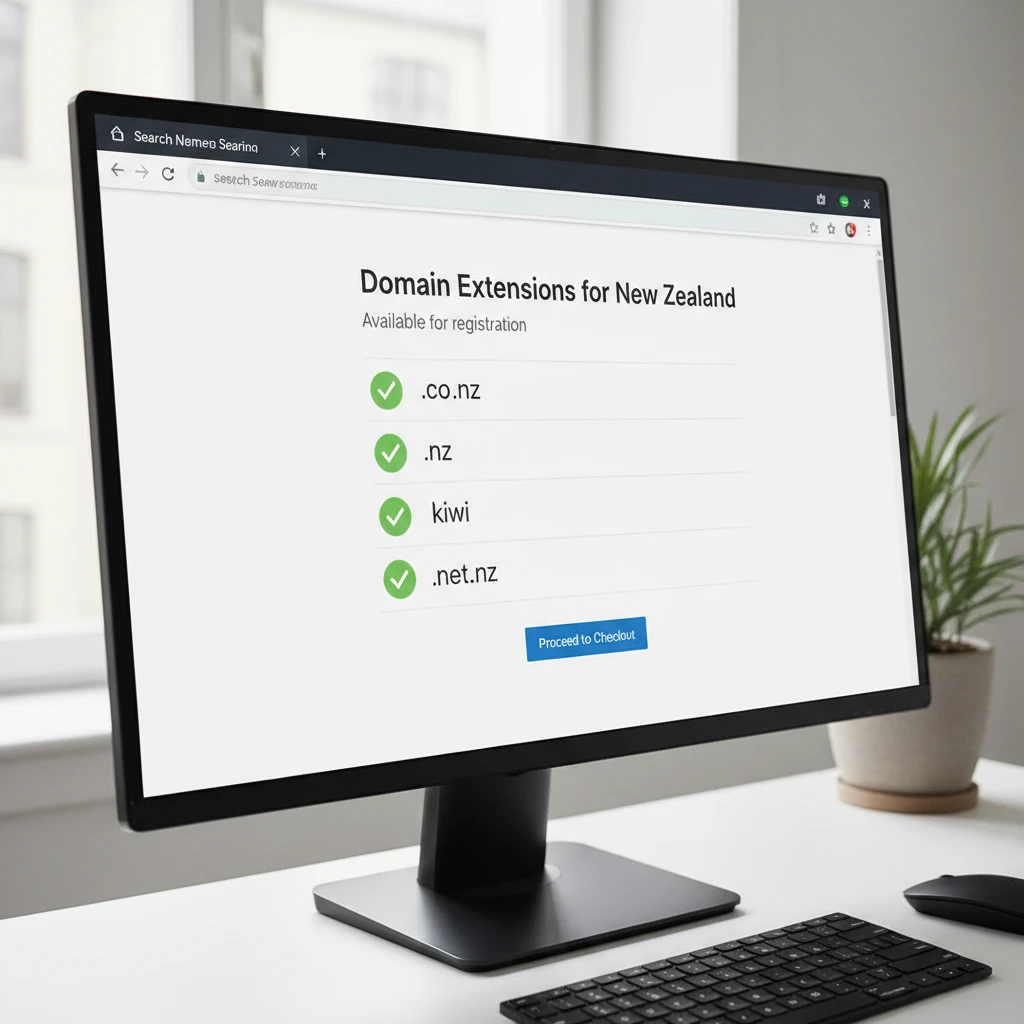
Priority Extensions: .co.nz, .nz, and .kiwi
Not all domain extensions are created equal. When formulating a defensive domain registration NZ strategy, you must prioritize based on user behavior and market authority. A “spray and pray” approach where you buy every extension is often cost-prohibitive, so a tiered approach is recommended.
Tier 1: The Essentials
These are non-negotiable for any serious NZ business.
- .co.nz: The gold standard. Even if you use .com or .nz as your primary, you must own the .co.nz to prevent confusion.
- .nz: The shorter, modern equivalent. As mobile browsing increases, the brevity of .nz is becoming preferred. It is critical to own this to prevent a “split brand” situation.
Tier 2: The Secondary Layer
These extensions are important for broader protection and specific organizational types.
- .net.nz: Historically used by ISPs but now a common alternative when the .co.nz is taken. It is frequently targeted by squatters.
- .kiwi: An identity-based TLD. While less common for primary commerce, it is popular for marketing campaigns and “Buy NZ Made” initiatives.
- .com: If you are an NZ business, you still operate on the global web. Owning the .com is vital to prevent global traffic leakage.
Tier 3: Niche and Defensive
- .org.nz: Essential if you are a non-profit, but commercial entities often register this defensively to prevent fraudulent “charity” sites using their name.
- .geek.nz / .gen.nz: Less critical, but low-cost options for total lockdown.
Typosquatting: Protecting Against Human Error
Typosquatting relies on the inevitability of human error. Users often mistype URLs, and predatory registrants capitalize on this by registering the misspelled versions. A robust defensive strategy analyzes the keyboard layout and phonetic spellings of a brand name.
Common Typosquatting Tactics
- The “Fat Finger” Error: Registering keys adjacent to the correct letters on a QWERTY keyboard (e.g., exanple.co.nz instead of example.co.nz).
- Omission: Leaving out a letter (e.g., exmple.co.nz).
- Duplication: Doubling a letter (e.g., exampple.co.nz).
- Hyphenation: Adding a hyphen where there shouldn’t be one (e.g., your-brand.co.nz).
- Singular vs. Plural: If your brand is “Smith Solutions”, secure “SmithSolution.co.nz”.
For high-value brands, it is advisable to conduct a “typo audit” to identify the most likely misspellings and register them. These domains should then be 301 redirected to your primary website, capturing lost traffic rather than letting it hit a dead end or a competitor’s site.

Balancing Budget vs. Brand Protection
One of the most common questions regarding defensive domain registration in NZ is: “How much is too much?” It is easy to spend thousands annually on domains that never see active use. The key is to view this expenditure not as an IT cost, but as a legal and marketing insurance premium.
Calculating the Risk Cost
To determine your budget, compare the cost of registration against the potential cost of recovery. In New Zealand, a standard domain fee might range from $20 to $50 NZD per year. In contrast, filing a complaint with the Domain Name Commission’s Dispute Resolution Service (DRS) can cost significantly more in legal fees, time, and stress, with no guarantee of success.
The “Watch and Acquire” Approach
For businesses with limited budgets, you cannot register every possibility. Instead, employ a “Watch and Acquire” strategy:
- Register the exact match Tier 1 and Tier 2 domains immediately.
- Monitor the Tier 3 and typo variations using brand monitoring software.
- Acquire only if traffic analytics suggest a specific misspelling is common, or if monitoring alerts you to a registration attempt by a third party (using backordering services).
Role of Trademark Clearinghouses and Legal Recourse
For businesses operating globally or protecting against new Generic Top-Level Domains (gTLDs like .shop, .store, .business), the Trademark Clearinghouse (TMCH) is a vital tool. While the TMCH is centralized for global domains, understanding local NZ protections is equally important.
The Domain Name Commission (DNC) and DRS
New Zealand has a robust framework managed by the DNC. If you fail to register a domain defensively and it is taken by a squatter, your primary recourse is the Dispute Resolution Service (DRS). To succeed in a DRS dispute, you generally need to prove:
- You have rights (usually trademark rights) in a name or mark that is identical or similar to the domain name.
- The registration of the domain name in the hands of the registrant is an “unfair registration.”
An “unfair registration” typically means the domain was registered in a manner that took unfair advantage of, or was detrimental to, your rights. While the DRS is effective, it is reactive. Defensive registration is proactive.

Adult Blocking and DPML
For specific gTLDs, services like the Domains Protected Marks List (DPML) allow trademark holders to block their terms across hundreds of extensions for a flat fee. While this doesn’t apply directly to .nz (which requires individual registration), it is a crucial component of a holistic strategy for NZ exporters.
Executing Your Defensive Strategy
To implement a successful defensive domain registration strategy in New Zealand, follow this step-by-step workflow:
1. Audit Your Portfolio
List all domains currently owned. Identify gaps in Tier 1 (.co.nz, .nz) and Tier 2 (.net.nz, .kiwi).
2. Identify High-Risk Variations
Use online tools to generate common misspellings and check their availability. Prioritize those that result in embarrassing words or direct competitors.
3. Set Up Redirects
A defensive domain sitting idle is a wasted asset. Configure 301 (permanent) redirects for all defensive domains to point to your main homepage or specific landing pages. This captures traffic and signals to search engines that these domains are related to your brand.
4. Review Annually
The domain landscape changes. New extensions are released, and your brand may evolve. Schedule an annual review of your domain portfolio to drop unnecessary domains and pick up new strategic assets.
In the competitive New Zealand market, your digital identity is your storefront. Defensive domain registration is not paranoia; it is prudent business practice. By securing the .nz namespace and its variations, you build a fortress around your brand that protects your reputation and your bottom line.
What is the difference between .co.nz and .nz?
.co.nz is the traditional, established extension for commercial entities in New Zealand. .nz is the newer, shorter extension that allows for registration at the second level. While .co.nz implies “company,” .nz is generic and can be used by anyone. Businesses should ideally secure both to protect their brand.
How much does defensive domain registration cost in NZ?
The cost depends on the number of domains and the registrar used. Typically, a .nz or .co.nz domain costs between $20 and $50 NZD per year. A comprehensive defensive strategy with 10-20 domains might cost $400-$1000 annually, which is significantly cheaper than legal fees for a single dispute.
Can I recover a domain if someone else registers it?
Yes, through the Domain Name Commission’s Dispute Resolution Service (DRS). However, you must prove you have rights to the name and that the current registration is unfair (e.g., cybersquatting). This process takes time and money, making defensive registration the better preventative option.
Should I register the .net.nz extension?
Yes, if your budget allows. While less popular than .co.nz, .net.nz is a recognized local extension. If you do not register it, a competitor or scammer might, potentially confusing your customers who recall your name but guess the wrong extension.
What is a “confusingly similar” domain?
A domain is confusingly similar if it visually or phonetically resembles your trademark or business name enough to mislead consumers. This includes typos (e.g., gooogle.com), visual lookalikes (homoglyphs), or adding generic terms (e.g., brandname-shop.co.nz).
Do I need a trademark to register a .nz domain?
No, .nz domains are generally sold on a first-come, first-served basis. You do not need a registered trademark to buy a domain. However, having a registered trademark helps significantly if you ever need to dispute a domain registration held by someone else.
