


Privacy Options for NZ Domains
NZ domain WHOIS privacy, primarily facilitated through the Individual Registrant Privacy Option (IRPO), allows individual registrants to conceal their physical address and telephone number from the public .nz register. This option is available exclusively to individuals not using the domain for significant trade, ensuring personal safety while maintaining contactability through the Domain Name Commission.
What is the Individual Registrant Privacy Option (IRPO)?
The landscape of digital identity in New Zealand is governed by a balance between transparency and personal safety. Unlike generic top-level domains (gTLDs) like .com or .net, which often utilize third-party proxy services to mask ownership data, the .nz namespace operates under strict policies set by the Domain Name Commission (DNC). The primary mechanism for privacy in this localized environment is the Individual Registrant Privacy Option (IRPO).
The IRPO was designed to address the growing concern regarding the public availability of personal contact details on the WHOIS (now often referred to as the Query Service). Historically, anyone could search a domain and see the owner’s full name, physical address, email, and phone number. For businesses, this transparency builds trust. For individuals running personal blogs or hobby sites from home, this posed a significant privacy risk.
When the IRPO is applied to a domain name, the public query results change significantly. While the registrant’s name and email address may still be visible (depending on specific registrar implementations and DNC updates), the physical address and telephone number are withheld from public view. This prevents data scraping by spammers, reduces the risk of harassment, and protects the physical security of the registrant.
The Philosophy Behind .nz Transparency
New Zealand’s domain policy is built on the premise that if you own a slice of the internet, you must be contactable. This is vital for resolving intellectual property disputes, technical issues, or legal matters. Therefore, the IRPO is not an anonymity cloak for illegal activity. The DNC retains the unredacted data, and there are established protocols for requesting this information if there is a legitimate legal reason, such as a breach of the Fair Trading Act or defamation.
Who Is Eligible for NZ Domain Privacy?
One of the most critical aspects of nz domain WHOIS privacy is understanding that it is not available to everyone. The DNC strictly delineates between “individuals” and “entities” (such as businesses, organizations, or societies).
Individuals vs. Trading Entities
To be eligible for the IRPO, you must be an individual registrant. This means the domain is registered in your personal name, not the name of a Limited Liability Company (LLC), a trust, or a registered charity. Furthermore, the domain must not be used for “significant trade.”
This distinction is crucial for New Zealand domain brokerage and escrow services. If a domain is flagged as being used for commercial purposes, the DNC policy mandates transparency so that consumers know who they are doing business with. If you are selling goods, offering professional services, or operating an e-commerce store on a .nz domain, you are generally considered to be in trade, and thus, you are not eligible for the IRPO.

Key Eligibility Checklist:
- Registrant Name: Must be a natural person (e.g., “John Doe”), not a company.
- Usage: Personal use, hobby, family portal, or very low-level activity that does not constitute significant trade.
- Commercial Intent: If the site generates significant revenue or acts as a primary business front, privacy may be revoked.
How to Hide Your Home Address on .nz Records
Enabling the IRPO is a straightforward process, but it must be done through your specific registrar (the company where you bought your domain, such as Crazy Domains, 1st Domains, or Metronet). The DNC manages the central registry, but registrants interact with registrars.
Step-by-Step Activation Guide
- Log in to your Registrar Console: Access the dashboard where you manage your domain names.
- Locate Domain Settings: Find the specific .nz domain you wish to protect.
- Select Privacy/WHOIS Options: Look for a setting labeled “Individual Registrant Privacy Option,” “WHOIS Privacy,” or “Hide Contact Details.” Note that terminology may vary slightly between registrars.
- Confirm Eligibility: You will likely be asked to tick a box confirming that you are an individual and not a trading entity. Making a false declaration here can lead to the cancellation of your domain.
- Save Changes: Once applied, the update propagates to the central registry.
It is important to verify the changes. You can do this by using the dnc.org.nz query tool to search your domain. Ensure your address and phone number are no longer displayed. If they still appear after 24 hours, contact your registrar’s support team.
The Ban on Proxy Services in .nz
In many international markets, domain investors and privacy advocates use “Proxy Services.” This is where a third-party company registers the domain in their name on your behalf, effectively shielding your identity completely. For example, a WHOIS search might show “Privacy Protect LLC” instead of your name.
Critically, the .nz policy prohibits the use of proxy services.
The DNC requires that the true registrant is listed in the official register. The logic is that the person or entity legally responsible for the domain must be identifiable. While the IRPO hides specific contact fields, the registrant field must accurately reflect the legal owner. This is a significant deviation from the .com world and is a vital piece of knowledge for anyone involved in NZ domain brokerage.
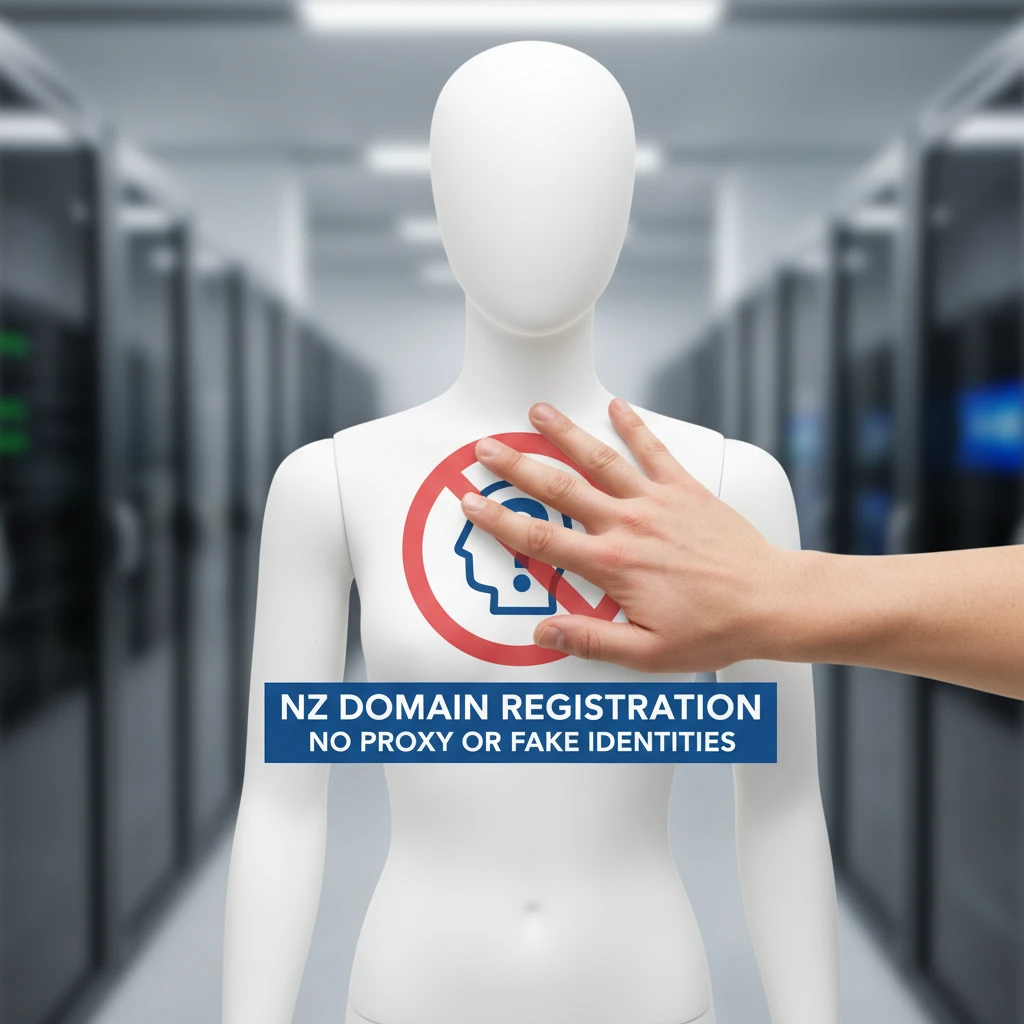
Using a fake name or a proxy service to bypass these rules puts your asset at risk. If a dispute arises and the registrant details are found to be false or a proxy, the DNC has the authority to cancel the domain name registration, potentially causing the loss of a valuable digital asset.
Impact of Privacy on Domain Sales and Trust
For the NZ Domain Brokerage and Localized Escrow Services market, the IRPO presents both challenges and opportunities. Privacy is excellent for security, but transparency is the currency of trust in high-value transactions.
Verifying Ownership During Escrow
When a domain is under IRPO, a potential buyer cannot easily verify who owns the domain simply by looking at the public record. This necessitates the use of a trusted intermediary or escrow service.
The Broker’s Role:
A professional broker must verify that the seller is indeed the legal registrant. Since the public WHOIS is redacted, the broker will typically require the seller to:
- Provide a screenshot of the registrar backend showing the unredacted details.
- Temporarily disable IRPO to allow for a verification spot-check (though this is less common due to privacy concerns).
- Use an authorization code (UDAI) which implicitly proves control over the domain.
Does Privacy Hinder Inbound Offers?
One downside of enabling nz domain WHOIS privacy is that it makes it harder for potential buyers to contact you. If an investor wants to buy your premium .nz domain, they cannot find your phone number or address.
However, the DNC mandates that a contactable email address or a functioning contact form mechanism must be available. Often, the visible email in the public register (if not hidden) or the “Registrant Contact Email” is the only bridge. Smart domain investors engaging in the NZ market often set up a dedicated generic email (e.g., admin@domainname.nz) that forwards to their main inbox, ensuring they don’t miss inquiries while keeping their personal email private.

Registrant Obligations Under Privacy
Enabling privacy does not absolve the registrant of their legal duties. In fact, it arguably increases the responsibility to ensure the hidden data is accurate. The DNC conducts periodic data validation checks. If your hidden address is invalid (e.g., mail bounces back) or your phone number is disconnected, you risk losing the domain.
The “Non-Disclosure” Option
It is important to distinguish the IRPO from the “Non-Disclosure” direction. The IRPO is a standard setting for eligible individuals. However, in extreme cases where there is a threat to safety (such as victims of domestic violence or individuals under protection orders), a registrant can apply directly to the DNC for a Non-Disclosure Direction.
This is a higher level of secrecy where all details, including the name and email, are withheld from the public register. This is not a setting you can toggle in a registrar console; it requires a formal application and usually supporting documentation (like a police report or court order).
People Also Ask
Can businesses hide their details on .nz domains?
Generally, no. Businesses and entities ‘in trade’ are required to have their contact details publicly visible on the .nz register to ensure consumer transparency and trust.
Does .nz domain privacy cost extra?
Unlike many international registrars that charge for WHOIS privacy, the IRPO is a policy feature of the .nz registry and is typically offered for free, though some registrars may bundle it differently.
What information is hidden by the IRPO?
The IRPO specifically hides the registrant’s physical address and telephone number. The registrant’s name and email address may still be displayed depending on the registrar’s implementation and DNC rules.
How do I contact a domain owner who has privacy enabled?
You can attempt to email the address listed in the WHOIS query (if visible) or use the ‘text-based’ query service on the DNC website which may facilitate a message relay if the email is redacted.
Is WHOIS privacy the same as GDPR protection?
Not exactly. While GDPR is a European regulation that redacts data by default, the .nz IRPO is a specific policy for New Zealand that requires an active choice (opt-in) by the registrant based on eligibility.
Can the DNC reveal my private data?
Yes, the Domain Name Commission can release withheld information if there is a legitimate reason, such as a Memorandum of Understanding (MoU) with law enforcement or a valid request regarding a breach of legislation.
