


GST and Tax Reporting for Domains
GST on NZ domain sales is mandatory for any New Zealand entity registered for GST, charged at the standard rate of 15% on the sale price. However, if the domain is sold to a non-resident buyer who is outside New Zealand at the time of supply, the transaction may be zero-rated for GST purposes.
For domain investors, brokers, and digital asset managers in New Zealand, navigating the tax landscape is as critical as securing a premium .nz URL. Unlike physical real estate, the tax treatment of digital assets involves specific nuances regarding intangible property, cross-border supply rules, and the distinction between capital gains and trading income. Whether you are flipping domains for profit or holding them as long-term brand assets, understanding your obligations to the Inland Revenue Department (IRD) is essential to protect your margins.
Understanding GST on NZ Domain Sales
Goods and Services Tax (GST) in New Zealand is a value-added tax of 15% applied to most goods and services supplied in New Zealand. For domain name investors and brokers, the application of GST depends entirely on your registration status and the nature of your “taxable activity.”
If your turnover from domain trading (and other taxable activities) exceeds, or is expected to exceed, NZD $60,000 in any 12-month period, you must register for GST. Once registered, you are legally required to charge 15% GST on any domain sold to a New Zealand resident. This amount is collected on behalf of the government and must be remitted to the IRD when you file your GST return.
The “Taxable Activity” Test
The IRD defines a taxable activity as any activity carried on continuously or regularly that involves the supply of goods or services to others for a consideration. If you are a casual hobbyist selling one domain every five years, you likely do not meet this threshold. However, if you are actively buying and selling domains (a domain flipper) or operating a brokerage, this constitutes a taxable activity.
How to Issue a Valid NZ GST Receipt for a Domain
When you close a deal—whether directly or through a localized escrow service—providing a valid tax invoice is non-negotiable for B2B transactions. Business buyers need this document to claim back the GST component of the purchase price.
Requirements for Supplies Over $1,000
Given that premium .nz domains often sell for well over $1,000, your tax invoice must be comprehensive. It must clearly display:
- The words “Tax Invoice” in a prominent place.
- The name and registration number (GST number) of the supplier (you).
- The name and address of the recipient (the buyer).
- The date upon which the tax invoice is issued.
- A description of the goods (e.g., “Transfer of ownership rights for domain name example.co.nz”).
- The quantity or volume of the goods supplied (usually “1”).
- The total amount payable excluding GST, the GST amount, and the total including GST; OR a statement that the total amount includes GST.
The Role of Escrow in Invoicing
In the New Zealand domain brokerage market, using an escrow service adds a layer of complexity to the “Time of Supply.” Generally, the time of supply for GST purposes is the earlier of:
- The time an invoice is issued; or
- The time any payment is received.
When funds are held in escrow, the payment is technically not “received” by the seller until released by the escrow agent. However, it is best practice to issue the tax invoice upon the agreement of sale so the buyer can arrange payment, noting that the transfer of the digital asset will occur upon fund clearance.
Claiming GST Back on Domain Acquisitions
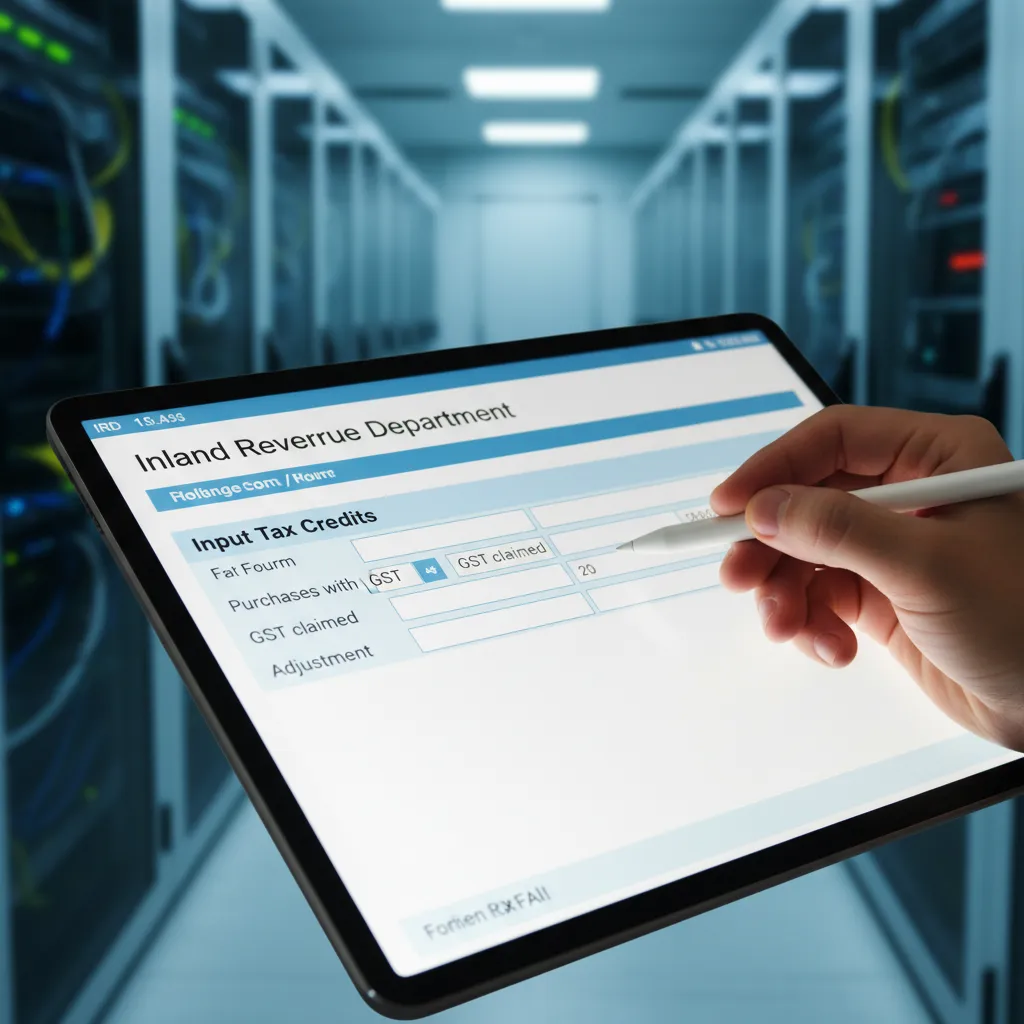
One of the primary benefits of being GST-registered is the ability to claim Input Tax Credits. If you purchase a domain to use in your taxable activity (e.g., to resell it or to build a website for your business), you can generally claim back the 15% GST paid.
Buying from GST-Registered Suppliers
This is straightforward. If you buy a domain from a registrar like GoDaddy (which charges NZ GST) or a registered NZ domain broker, you use the tax invoice they provide to claim the GST portion in your next return.
The “Second-Hand Goods” Input Tax Credit
This is a crucial, often overlooked rule for domain investors. In New Zealand, if a GST-registered person buys a “second-hand good” from a non-registered person (e.g., a private individual), they can still claim a GST input tax credit, even though the seller didn’t charge GST.
Does a domain count as a second-hand good?
Yes. If the domain has been previously owned and is being sold by a private party to you (a registered entity) for your business, you can generally claim a credit equal to the tax fraction (3/23rds) of the purchase price.
Conditions:
- You must hold a record of the supply (date, description, amount, seller details).
- You must have paid for the domain.
- The domain must be situated in New Zealand (which .nz domains inherently are regarding the registry, though residency rules can be complex).
Note: Always consult a tax accountant before claiming second-hand goods credits on high-value intangible assets to ensure you meet all IRD criteria.
Tax Treatment of Domains as Intangible Assets in NZ
Beyond GST, you must consider how the domain sits on your balance sheet. In New Zealand tax law, the classification of a domain name determines its deductibility and depreciation status.
Capital vs. Revenue Nature
Revenue (Trading Stock): If you are in the business of buying and selling domains, your domains are considered trading stock. The cost of acquiring them is deductible, and the full sale price is taxable income. They are treated similarly to inventory in a retail store.
Depreciation of Domain Names
This is a common area of confusion. Under NZ tax rules, intangible assets can only be depreciated if they are listed in Schedule 14 of the Income Tax Act 2007.
Are domain names depreciable?
Generally, no. The IRD views standard domain names as having an indefinite life; therefore, they cannot be depreciated. Unlike a patent or a copyright with a fixed expiry, a domain can be renewed indefinitely. However, the registration fees (the annual cost paid to the registrar) are fully deductible as an operating expense in the year they are incurred.
Reporting Domain Income to the IRD
Transparency with the IRD is vital. The digital economy is under increasing scrutiny, and crypto-assets and domain names are on the radar. How you report income depends on your intent at the time of acquisition.
The “Intention of Resale”
New Zealand does not have a comprehensive Capital Gains Tax, but it does have strict rules regarding property acquired with the purpose or intention of disposal. Section CB 3 (for personal property) or CB 4 (for business property) of the Income Tax Act essentially states that if you bought the domain with the intent to sell it, the profit is taxable income.
If you are a domain investor:
- Income Tax Return (IR3 or IR4): You must declare the net profit from your domain sales as business income.
- Inventory Valuation: You may need to value your unsold domains (trading stock) at the end of the financial year, usually at the lower of cost or market value.
Cross-Border Sales and Zero-Rating
The global nature of the internet means you will often sell .nz domains to buyers in the USA, Europe, or Australia. This impacts your GST obligations significantly.
When to Zero-Rate the Supply
If you sell a domain to a buyer who is not resident in New Zealand and is outside New Zealand at the time of the service being performed, you can likely charge GST at 0% (zero-rated).
This is beneficial because:
- You do not have to add 15% to your asking price, making the asset more attractive to international buyers.
- You can still claim back GST on your expenses (like legal fees or local brokerage commissions) related to that sale.

Evidence Required for Zero-Rating
You cannot simply assume a buyer is overseas. You must retain evidence to satisfy the IRD, such as:
- The buyer’s IP address (often captured by escrow services).
- The buyer’s billing address and country of residence.
- Confirmation that the buyer is not in New Zealand at the time of the transaction.
People Also Ask
Do I pay GST on GoDaddy domains in NZ?
Yes. Since 2016, overseas providers of “remote services” (digital products) to New Zealand residents have been required to collect and remit 15% GST. GoDaddy and other major international registrars will charge you GST if you are a New Zealand resident. If you are GST registered, you can claim this back.
Is selling a domain name taxable income in NZ?
It depends on your intent. If you bought the domain with the intention of selling it, or if you are in the business of trading domains, the profit is fully taxable as income. If you bought it for a business that failed and you are selling off assets, it might be a capital receipt, but specific tax advice is recommended.
Can I claim GST on a second-hand domain purchase?
Yes, provided you are GST registered and the seller is not. You can generally claim a credit of 3/23rds of the purchase price for second-hand goods acquired for your taxable activity, provided you hold the necessary records of the sale.
What is the depreciation rate for domain names in NZ?
Domain names generally have a depreciation rate of 0% in New Zealand. The IRD views them as having an indefinite life. However, related costs like website development software may be depreciable, and annual renewal fees are fully deductible expenses.
Do I need to register for GST to sell a domain?
You only need to register for GST if your total turnover from all taxable activities exceeds NZD $60,000 in a 12-month period. If you are below this threshold, you do not need to register, and you cannot charge GST on the sale.
How are domain names classified on the balance sheet?
Domain names are classified as Intangible Assets. If held for resale, they may be classified as Inventory (Current Assets). If held for long-term business use, they are Non-Current Intangible Assets.
