

In New Zealand, legal ownership of social handles is distinct from property ownership. While platforms retain technical ownership of accounts, the Trade Marks Act 2002 allows businesses to reclaim handles that infringe on registered intellectual property. Without a trademark, proving “passing off” under the Fair Trading Act 1986 is required to force a transfer.
In the digital economy, a social media handle is more than just a username; it is a critical business asset, a customer touchpoint, and a piece of intellectual property. However, for many New Zealand businesses, the realization that they do not technically “own” their social media presence comes too late—usually after a dispute arises.
Understanding the legal ownership of social handles in NZ requires navigating a complex intersection of platform Terms of Service (ToS), New Zealand intellectual property law, and international dispute resolution procedures. Whether you are a startup looking to secure your brand identity or an established enterprise fighting off impersonators, the rules of engagement are specific and unforgiving.

The NZ Legal Framework: Trademarks vs. Usernames
The most common misconception among Kiwi business owners is that registering a company name with the New Zealand Companies Office grants rights to that name on social media. It does not. Company registration and intellectual property rights are entirely separate legal concepts.
Does a Username Count as Property?
Under strict legal definitions, a social media username is not property. You cannot hold a title deed to an Instagram handle in the same way you hold a title to land or a vehicle. Instead, you hold a license to use that space, granted by the platform (Meta, TikTok, X, etc.) subject to their Terms of Service.
However, this license can be challenged if it conflicts with New Zealand IP law. There are two primary statutes that offer protection:
- The Trade Marks Act 2002: This is your strongest weapon. If you hold a registered trademark with the Intellectual Property Office of New Zealand (IPONZ) for your brand name, you have the exclusive right to use that mark in trade. If a third party uses your trademarked name as a handle to sell similar goods or services, this constitutes infringement.
- The Fair Trading Act 1986: If you do not have a registered trademark, you must rely on common law rights regarding “passing off.” You must prove that the current holder of the handle is engaging in misleading or deceptive conduct, causing the public to believe their account is associated with your business.
The “Use in Trade” Requirement
For a legal claim to succeed, the handle usually needs to be used “in the course of trade.” A teenager in Wellington who registered @YourBrandName in 2012 to post personal cat photos is likely not infringing on your trademark because they are not competing commercially. However, if a competitor grabs the handle to divert your traffic, the legal standing shifts dramatically.
Squatters Rights: When Can You Force a Transfer?
“Cybersquatting” refers to the practice of registering names, trademarks, or slogans as usernames with the intent to profit from the goodwill of someone else’s trademark. While domain name disputes have clear resolution policies (like the UDRP), social media handles exist in a murkier legal territory.

Active Impersonation vs. Passive Holding
Platforms distinguish heavily between active and passive accounts. This distinction often determines whether you can recover a handle without paying for it.
- Active Impersonation: The account uses your logo, your business name, and posts content attempting to look like you. This is a violation of almost every platform’s ToS and NZ’s Fair Trading Act. Recovery is highly likely with proper reporting.
- Passive Holding (Dormancy): The account was registered years ago, has zero posts, and the user is inactive. Surprisingly, this is not illegal. Merely holding a name is not trademark infringement because there is no “use in trade.”
The “Generic Word” Hurdle
If your desired handle is a generic word (e.g., @CoffeeNZ or @BuilderAuckland), you have almost no legal recourse to force a transfer, even if you have a company with that name. Courts and platforms rarely grant exclusivity over generic descriptive terms unless they have acquired “secondary meaning” (where the public exclusively associates that generic term with your specific brand—a very high bar to clear).
Platform-Specific Dispute Resolution (Meta & TikTok)
When legal letters fail, you must utilize the platforms’ internal trademark infringement reporting tools. These mechanisms are governed by US law (typically the DMCA and the Lanham Act) but respect New Zealand trademark registrations.
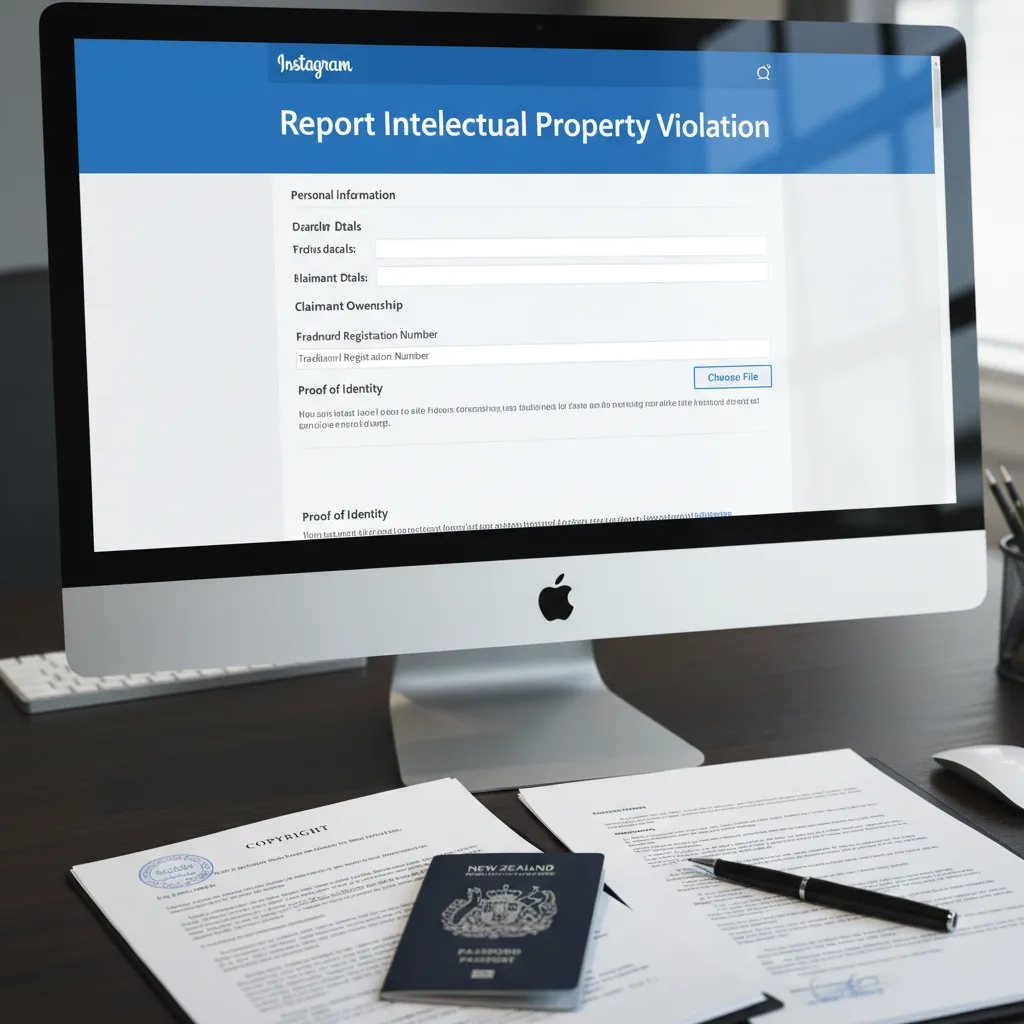
How to file a trademark dispute on Meta (Instagram/Facebook)
Meta is notoriously difficult to contact, but they have a structured legal takedown process. To succeed, you cannot simply request a handle; you must report a violation.
- Prepare Your IPONZ Documentation: You need your trademark registration number and a digital copy of your certificate from the IPONZ register.
- Locate the Form: Navigate to the Instagram Help Center and search for “Report a Trademark Violation.” Do not use the standard “Report User” button on the profile; use the dedicated legal form.
- Specifics Matter: In the description, clearly state: “The user @handle is using my registered trademark [Number] to mislead consumers in New Zealand. This violates the Trade Marks Act 2002 and Meta’s Terms of Service regarding intellectual property.”
- The Outcome: Meta will rarely transfer the handle to you immediately. They will usually delete the infringing account. Once deleted, you must be ready to register it immediately, or use a media partner portal to request the transfer into your account.
How to file a dispute on TikTok
TikTok’s policy is stricter regarding “username squatting.” Their policy explicitly states that usernames are provided on a first-come, first-served basis, but they also prohibit trademark infringement.
If you are filing a report on TikTok, you must prove a likelihood of confusion. Unlike Meta, TikTok is sometimes more responsive to “impersonation” claims than complex trademark disputes. If the account is re-posting your content, file a Copyright Takedown (DMCA) first to get strikes against the account, then follow up with a Trademark claim to secure the handle.
The Grey Market: Buying and Selling Handles
Given the difficulty of legal recovery, many NZ businesses consider buying the handle from the current owner. This is known as the “Grey Market.” It is termed grey because while it isn’t illegal under NZ criminal law, it is a violation of the Terms of Service of every major social platform.
The Risks of Purchasing
If you pay $5,000 for an Instagram handle, you are purchasing a digital asset that the platform can revoke at any moment. If Instagram detects the transfer (e.g., login IP changes from London to Auckland instantly), they may ban the account for “account trafficking.”
Best Practices for Acquisition
If you must acquire a handle via purchase, consult with a Digital Asset Broker who understands the technical nuances of secure transfer. This usually involves:
- Escrow Services: Never pay via direct bank transfer or crypto without a third-party holding funds.
- Gradual IP Transition: Slowly changing the login location and recovery details over weeks, not minutes, to avoid triggering security algorithms.
- Asset Purchase Agreements: Drafting a contract that explicitly states you are purchasing the “goodwill and consulting services” of the previous owner, rather than the account itself, to provide a thin layer of legal cover.
Brand Guardian Guide: Securing Assets Early
The most effective legal strategy regarding social handles is prevention. As a Brand Guardian, your goal is to secure a defensive perimeter around your digital identity before you even launch.

The “Username Audit” Protocol
Before registering a company name in New Zealand, conduct a Username Audit. Use tools like Namechk to see if your exact match handle is available across all platforms. If @YourBrand is taken on Instagram but available on TikTok, reconsider your brand name or add a modifier immediately (e.g., @YourBrandNZ).
Unified Branding Strategy
If your primary handle is taken, consistency is your backup legal defense. By standardizing your handles (e.g., using @BrandNameOfficial across X, TikTok, and Instagram), you build a stronger case for “passing off” if someone later tries to impersonate you using a variation. This establishes a pattern of genuine commercial activity that NZ courts recognize.
Trademark Classes
When filing your trademark with IPONZ, ensure you register in classes relevant to digital media and online services (often Class 35 for advertising/business and Class 41 for entertainment/education). This specific coverage makes it much harder for platforms to ignore your takedown requests.
People Also Ask
Can I sue someone for using my business name on Instagram in NZ?
Yes, but only under specific circumstances. If you have a registered trademark, you can sue for infringement. If not, you can sue for “passing off” under the Fair Trading Act 1986, provided you can prove they are misleading the public and damaging your business reputation.
Is it illegal to sell social media accounts in New Zealand?
It is not illegal under New Zealand criminal law to sell a social media account. However, it violates the Terms of Service of almost all platforms (Instagram, TikTok, Facebook). If the platform discovers the sale, they can permanently ban the account, leaving the buyer with nothing.
What happens to social media accounts when a business goes into liquidation?
Social media accounts are considered intangible assets. During liquidation, the liquidator can seize control of these accounts and sell them (or the rights to manage them) to pay off creditors, assuming the transfer doesn’t violate platform policies.
How much does it cost to trademark a name in NZ for social media protection?
As of the current fee structure, an online application with IPONZ costs $100 NZD (excluding GST) per class. Most businesses will need to register in at least two classes to fully cover their goods/services and their online presence.
Can I get a handle from an inactive user?
Generally, no. Platforms like Instagram and Twitter do not release inactive usernames upon request unless you have a valid trademark claim. Some platforms have policies to purge inactive users periodically, but these are unpredictable.
Does a domain name give me rights to the social handle?
No. Owning brand.co.nz gives you absolutely no legal right to the @brand handle on social media. They are separate registries with no legal crossover, although owning the domain can help prove your legitimacy in a dispute.
