


Dispute Resolution & DNC
An **NZ Domain Name Commission dispute** refers to the formal conflict resolution process managed by the .nz Domain Name Commission (DNC) regarding the registration or use of a .nz domain. This often involves the Dispute Resolution Service (DRS) to settle arguments over unfair registrations, trademark infringements, or ownership rights during business liquidation.
Resolving Ownership Conflicts During Business Dissolution
In the high-stakes environment of New Zealand digital asset liquidation and brokerage, the domain name is frequently the most undervalued yet critical asset. When a business enters liquidation, receivership, or voluntary dissolution, the ownership of the .nz domain name often becomes a point of contention. Unlike physical assets, digital assets are governed by a specific set of registry contracts and policies that can complicate the transfer of ownership.
A common scenario involves a discrepancy between the legal entity in liquidation and the listed “Registrant” of the domain. Historically, many NZ businesses allowed IT managers, web developers, or individual directors to register company domains in their personal names. When the company dissolves, these individuals may refuse to release the domain, holding it as leverage for unpaid wages or personal grievances. For a liquidator, this constitutes a blockage in realizing the full value of the company’s brand assets.
To resolve these conflicts effectively, one must first establish the “beneficial ownership” versus the “nominal ownership.” While the DNC register lists a specific contact, New Zealand law and the DNC policies recognize that if a domain was paid for by the company, used for company business, and represented the company’s goodwill, the beneficial ownership likely resides with the entity, not the individual listed. Documenting the paper trail of renewal payments and email usage is the first step in preparing a case for an NZ domain name commission dispute.
The NZ Domain Name Commission Dispute Resolution Service (DRS)
The primary mechanism for settling these arguments without resorting to the High Court is the Dispute Resolution Service (DRS). The DRS is a specialized service provided by the .nz Domain Name Commission designed to be faster and more cost-effective than traditional litigation. Understanding this process is mandatory for any broker or liquidator dealing with contested digital assets.
What is the DRS Process?
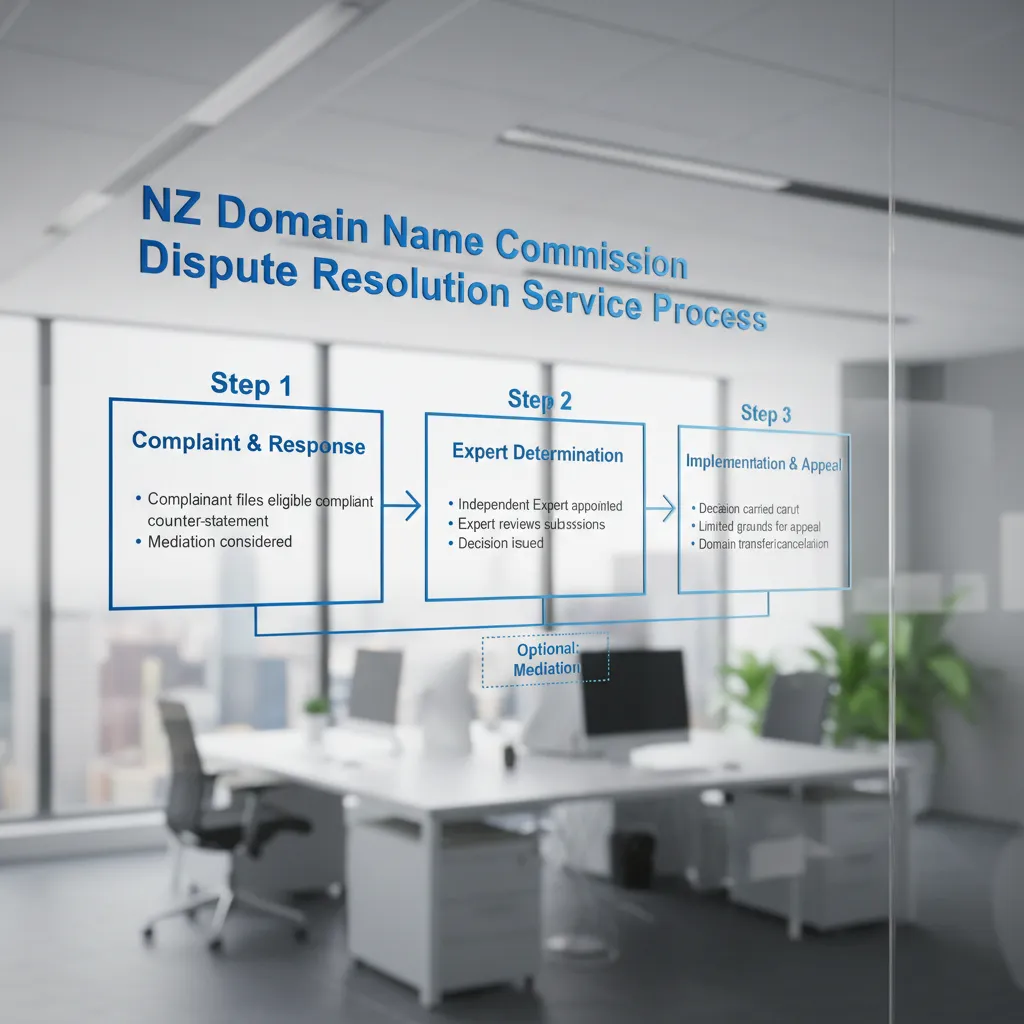
The DRS operates on a tiered system designed to encourage settlement before a binding decision is required. The process is strictly governed by the .nz Dispute Resolution Service Policy.
- 1. Informal Mediation: Once a complaint is lodged and the response is received, the DNC appoints a mediator. This is a free service where the mediator attempts to help both parties reach a mutually different agreement. In the context of liquidation, this is often where a liquidator can explain the legal inevitability of asset seizure to a recalcitrant director, prompting a voluntary transfer.
- 2. Expert Determination: If mediation fails, the Complainant can opt to pay a fee for an Expert to decide the case. The Expert is an independent adjudicator who reviews the submissions against the Policy criteria.
- 3. Appeal: Decisions can be appealed, though this incurs significant costs and is rare in standard commercial disputes.
The Threshold for Success: Rights and Unfair Registration
To succeed in an NZ domain name commission dispute, the Complainant must prove two distinct elements on the balance of probabilities:
- Rights: The Complainant has rights in respect of a name or mark which is identical or similar to the domain name. This does not strictly require a registered trademark; common law rights established through trading reputation are sufficient in New Zealand.
- Unfair Registration: The domain name, in the hands of the Respondent, is an Unfair Registration. This is a crucial distinction from the UDRP (international policy) which requires “bad faith.” The NZ policy is broader. An Unfair Registration is one where the registration or use of the domain takes unfair advantage of, or is unfairly detrimental to, the Complainant’s rights.
For liquidators, proving “Unfair Registration” often involves demonstrating that a former director is using the domain to divert traffic to a new competitor business, or is simply blocking the liquidator from selling the asset to pay creditors.
Handling Trademark Infringements in Insolvency
Insolvency proceedings often trigger a race to capture market share. Competitors may register typo-squatted variations of the insolvent company’s domain or purchase dropped domains to redirect traffic. This creates a complex layer of trademark infringement that must be managed alongside the liquidation.
When a business enters administration, the intellectual property (IP), including trademarks, vests in the control of the administrator. If a third party registers a domain that infringes on these trademarks, the administrator has a fiduciary duty to protect the value of that brand for potential buyers. An NZ domain name commission dispute is the most efficient tool here.
Cybersquatting and the “Blocking Registration”
A specific category of unfair registration relevant to this niche is the “Blocking Registration.” This occurs when a domain is registered not to be used, but to prevent the rightful owner (or the liquidator representing them) from using it. If a disgruntled creditor registers a variation of the company name to hold it ransom, the DRS provides a remedy.
It is vital to act quickly. Under the .nz policy, evidence of “trading off” the reputation of the insolvent company is strong grounds for transfer. If a competitor redirects `company-liquidation.co.nz` to their own site, they are likely confusing the public and infringing on the established rights of the entity in liquidation.
Recovering Hijacked Domains
Domain hijacking involves the illegal transfer of control of a domain name away from the legitimate registrant. In the chaos of business dissolution, security protocols often lapse, making dormant domains prime targets for hijacking. This can happen through credential stuffing, phishing attacks on the listed administrative contact, or social engineering aimed at the registrar.
Immediate Steps for Recovery
If you suspect a domain under your management has been hijacked, the NZ Domain Name Commission dispute process may be too slow for the immediate threat. The first step is to contact the specific Registrar (the retailer) involved.
However, if the hijacker has transferred the domain to a new Registrar or updated the registrant details to mask their identity, you must invoke the DNC’s intervention capabilities. While the DNC generally does not intervene in contractual disputes between a registrant and a registrar, they do have emergency powers in cases of clear fraud or where the integrity of the .nz register is threatened.
In cases of “rogue employee” hijacking—where an employee changes the password and refuses access—this is treated as a civil dispute rather than a criminal hack. Here, the DRS is the appropriate channel. You must provide employment contracts and evidence of the domain’s use for the employer’s benefit to prove that the employee holds the domain effectively on constructive trust for the company.

Legal Support for Complex Ownership Chains
Not all disputes are straightforward. In the world of high-value digital asset brokerage, ownership chains can be incredibly opaque. A domain might be registered by a subsidiary of a holding company that is owned by a family trust which is currently undergoing a restructure.
When to Engage Legal Counsel
While the DRS is designed to be accessible without lawyers, complex ownership structures require legal precision. If the “Complainant” is not clearly the entity with the rights (e.g., the rights are held by a parent company but the domain is used by a subsidiary), the complaint can fail on technical standing.
Legal support is particularly vital when dealing with:
- Offshore Registrants: If the domain is held by an entity outside of New Zealand jurisdiction, enforcing a High Court judgment is difficult. The DRS, however, is contractually binding on the Registrar. If the Expert orders a transfer, the .nz Registrar must comply regardless of where the Respondent is located.
- Multiple Rights Holders: In a partnership dissolution where both partners have equal claim to the brand, proving “unfairness” is difficult. A specialized lawyer can help frame the argument around specific contractual breaches or fiduciary duties that tip the balance of “fairness” in the DNC’s eyes.
Ultimately, navigating an NZ domain name commission dispute requires a blend of technical understanding and legal strategy. For liquidators and brokers, the domain is not just a web address; it is a tradable asset that must be secured, cleared of encumbrances, and liquidated for maximum value.
Frequently Asked Questions
How much does an NZ domain dispute cost?
Filing a complaint is free. Informal mediation is also free. However, if the matter proceeds to Expert Determination, the Complainant must pay a fee, typically around $2,000 NZD + GST, though this can vary based on the number of domains involved. If the Respondent opts for a 3-person panel, they may share the costs.
How long does the DRS process take?
The timeline varies, but it is generally much faster than court proceedings. Informal mediation usually takes 10-15 working days. If it goes to Expert Determination, the entire process from filing to decision typically takes between 60 to 90 days, depending on the complexity and extension requests.
Can I appeal a DNC decision?
Yes, either party can appeal an Expert Decision within 10 working days. However, an appeal requires a significantly higher fee (often exceeding $7,000 NZD) and is heard by a panel of three experts. Appeals are generally reserved for cases where a clear misinterpretation of the Policy has occurred.
What counts as unfair registration in NZ?
Unfair registration includes circumstances where the domain was registered to block the rights holder, to disrupt a competitor’s business, to confuse users into thinking the domain is affiliated with the complainant, or to sell the domain to the complainant for a profit in excess of out-of-pocket costs.
Do I need a lawyer for a domain dispute?
You are not required to have a lawyer. The DRS is designed to be accessible to laypeople. However, for high-value domains or complex cases involving insolvency and multiple stakeholders, legal representation is highly recommended to ensure submissions are legally sound.
What happens to a domain when a company is liquidated?
The domain is considered an asset of the company. The liquidator takes control of the domain. If the domain was registered in a director’s personal name but used for the company, the liquidator may need to use the DRS to force a transfer of ownership to the company estate for sale.
