


Acquisition & Expired Domains
Buying expired NZ domains involves acquiring web addresses that previous owners failed to renew, typically following a 90-day grace period mandated by the Domain Name Commission. Investors and businesses utilize backordering services or manual registration to secure these digital assets for their established SEO authority, existing traffic history, or premium branding potential within the New Zealand market.
In the competitive landscape of New Zealand’s digital economy, the acquisition of expired domains represents a sophisticated strategy for rapid growth. Whether you are looking to bolster an existing SEO profile through 301 redirects or acquire a premium keyword match for a new venture, understanding the mechanics of the .nz registry is paramount. This guide provides a transactional blueprint for navigating the secondary market, securing liquidated assets, and mitigating the risks associated with pre-owned domains.
How to Acquire Domains from Liquidated NZ Companies
When a New Zealand company goes into liquidation, its digital assets often fall into a state of limbo. Unlike physical assets which are immediately auctioned, domain names can slip through the cracks if the liquidators do not understand their intrinsic value. For the savvy investor, this presents a unique opportunity to buy expired NZ domains before they hit the open market or drop catchers.
Identifying Distressed Assets
The first step in this acquisition strategy is monitoring the New Zealand Companies Office for liquidation notices. Once a company enters liquidation, its domain name registration may lapse due to non-payment of renewal fees. However, proactive brokers often contact liquidators directly to make an offer on the domain portfolio before it expires.
The Legal Transfer Process
Acquiring a domain directly from a liquidator requires a formal change of registrant. In the .nz namespace, this is a regulated process. You must ensure that the individual signing the transfer has the legal authority to dispose of the company’s assets. This usually involves:
- Verifying the liquidator’s appointment via the Companies Office.
- Obtaining a UDAI (Unique Domain Authentication ID) from the current registrar.
- Executing a registrant transfer immediately to prevent the domain from entering the grace period where it might be intercepted by automated scripts.
Navigating the ‘Pending Release’ Status in .nz Registry
To successfully buy expired NZ domains, one must master the lifecycle defined by the Domain Name Commission (DNC). The .nz namespace operates differently from .com or .net, and misunderstanding these timelines will result in lost opportunities.
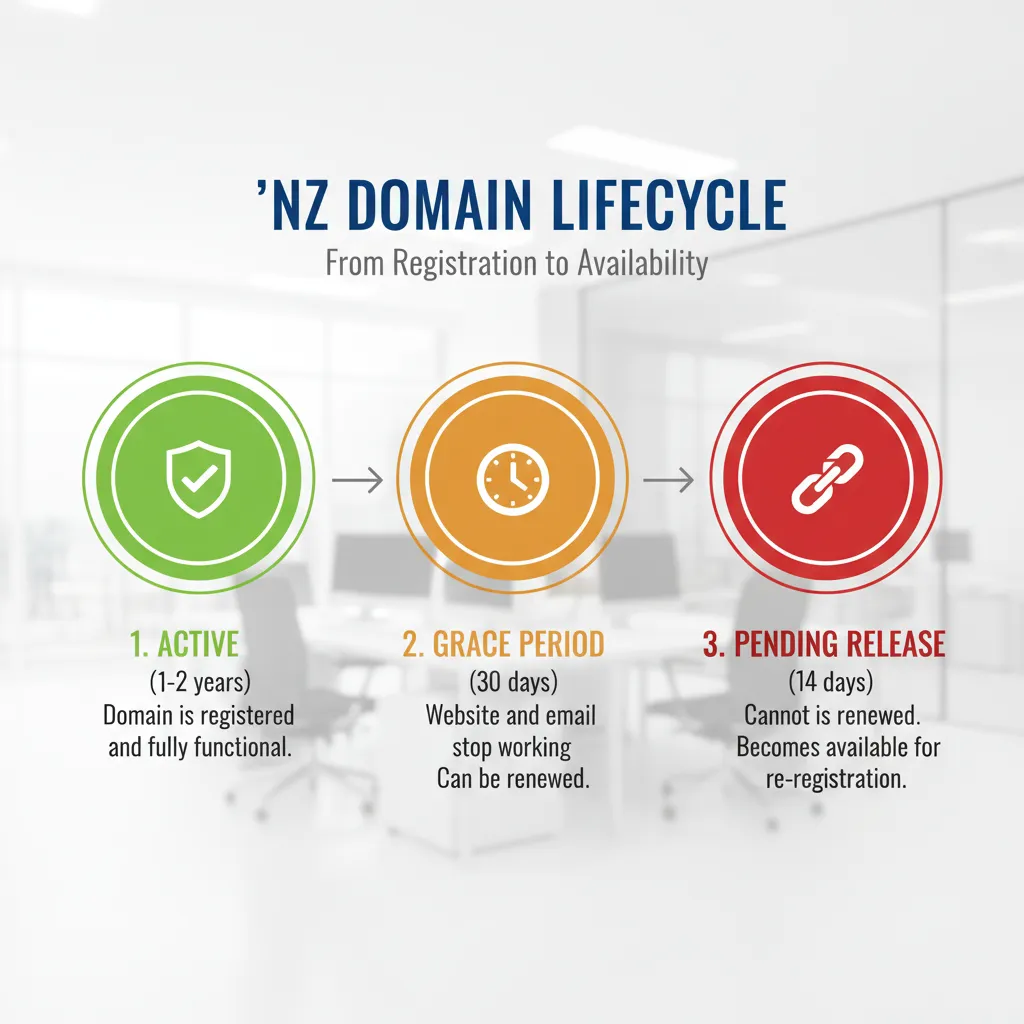
The .nz Domain Lifecycle
A domain does not become available the second it expires. It follows a strict trajectory:
- Active Status: The domain is live and registered.
- Grace Period (0-90 Days): If a renewal fee is missed, the domain enters a grace period. During this time, the original registrant can still renew the domain at the standard rate. The website may be taken offline, but the ownership is still locked.
- Pending Release (5 Days): After the 90-day grace period concludes, the domain enters ‘Pending Release.’ This is the critical window for investors. The domain cannot be renewed by the original owner during this phase without significant intervention, and it is scheduled to be dropped from the registry.
The Drop Time
In the .nz registry, domains in ‘Pending Release’ typically drop and become available for public registration at 1:00 PM NZT on the scheduled release day. However, relying on manual registration at 1:00 PM is a failing strategy for high-value keywords, as automated ‘drop catchers’ will claim the name in milliseconds.
Backordering High-Value Expired Domains
For domains with high domain authority (DA) or premium keyword value, manual registration is impossible due to the speed of automated scripts. To secure these assets, you must utilize backordering services, often referred to as “drop catching.”
How Drop Catching Works
Drop catching services have direct connections to the registry. They constantly ping the registry server, waiting for the exact millisecond a domain status changes from ‘Pending Release’ to ‘Available.’ When you place a backorder, you are essentially hiring their server power to register the domain on your behalf the instant it drops.
Selecting a Backorder Service
In New Zealand, there are specific registrars that specialize in .nz drop catching. When choosing a service to buy expired NZ domains, consider the following:
- Success Rate: Historical performance in catching competitive domains.
- Pricing Model: Some charge a flat fee, while others operate on an auction model if multiple users backorder the same domain.
- Registry Connections: The number of registrar connections (or “tags”) a service has determines how many attempts they can make per second. More tags usually equal a higher success rate.

Due Diligence: Checking for Toxic Backlinks and History
Not all expired domains are gold; some are radioactive. A domain may have been dropped because it was penalized by Google for spam, or used for illicit activities. Before investing money to buy expired NZ domains, rigorous due diligence is required.
Analyzing the Link Profile
The primary value of an expired domain often lies in its backlink profile. Use tools like Ahrefs, SEMrush, or Moz to audit the links pointing to the domain.
- Good Signs: Links from reputable NZ news sites (Stuff, NZ Herald), government bodies (.govt.nz), or educational institutions (.ac.nz).
- Red Flags: A high volume of links from foreign language sites, gambling sites, adult content, or link farms. These constitute “toxic” backlinks and can harm your money site if you 301 redirect the domain.
The Wayback Machine Check
Always check the domain’s history on Archive.org (The Wayback Machine). You need to see what content previously existed on the site.
If the domain was previously used for a legitimate business, it is a safe buy. If you see periods where the site hosted Chinese characters (often indicative of a hijack), pharmaceutical sales, or PBN (Private Blog Network) articles, avoid the domain. Google’s memory is long, and recovering a penalized domain is often more expensive than buying a fresh one.

Securing Premium Names for Brand Expansion
Beyond SEO metrics, buying expired NZ domains is a strategic play for brand protection and expansion. Acquiring generic keyword domains (e.g., loans.co.nz or builder.co.nz) can provide a significant competitive advantage.
The 301 Redirect Strategy
If the acquired domain has high topical relevance and authority, the most common strategy is a 301 redirect. This passes the “link juice” (authority) from the expired domain to your main business site. For this to work effectively, the redirected domain must be relevant. Redirecting a dog grooming domain to a car insurance site will likely yield no benefit and could trigger a manual penalty from Google.
Building Microsites
Alternatively, high-value domains can be developed into microsites or lead generation assets. By keeping the domain independent, you dominate more real estate on the Search Engine Results Page (SERP). This requires more effort in content creation but preserves the original domain’s integrity and allows for a broader market reach.
Frequently Asked Questions
Is it legal to buy expired domains in New Zealand?
Yes, it is entirely legal to buy expired domains in New Zealand. Once a registration lapses and the grace period ends, the domain returns to the public pool and can be registered by anyone. However, you should be cautious of trademark infringement. Owning a domain that matches a trademarked brand name can lead to disputes under the Domain Name Commission’s Dispute Resolution Service (DRS).
How long is the grace period for .nz domains?
The grace period for .nz domains is 90 days following the expiry date. During this time, the domain is inactive, but the original registrant retains the right to renew it. After 90 days, it enters a ‘Pending Release’ status for 5 days before becoming available to the public.
What is the difference between .co.nz and .nz?
.co.nz is the traditional extension for commercial entities in New Zealand and generally carries higher trust and recognition. .nz is the newer, shorter top-level domain. Both are valuable, but .co.nz is often preferred for established businesses, while .nz is popular for modern branding and shorter URLs.
Do expired domains keep their SEO ranking?
Expired domains do not keep their rankings indefinitely. Once a site goes offline, it begins to lose rankings. However, they do retain their backlink profile (historical authority). If you restore the content or redirect the domain quickly, you can salvage much of the SEO value (PageRank) associated with those incoming links.
How much does a backorder service cost in NZ?
Costs vary significantly. Some services charge a setup fee of $20-$50 NZD, while others operate on a “no win, no fee” basis. For highly contested premium domains, the price is often determined via an auction process among the interested parties, which can drive prices into the thousands.
Can I recover a domain after the Pending Release phase?
Once a domain completes the ‘Pending Release’ phase, it is dropped from the registry and becomes available for anyone to register. You cannot “recover” it in the sense of restoring the previous ownership rights; you must compete with the public and drop catchers to re-register it as a new owner.
