


Identifying Premium Assets
A premium domain is a high-value digital asset characterized by brevity, memorability, and commercial potential. In the New Zealand market, these typically include short .co.nz extensions, exact match keywords, or unique brandable names that drive organic traffic, command immediate authority, and offer significant competitive advantages for businesses seeking market dominance.
In the digital age, your domain name is more than just a web address; it is the cornerstone of your digital identity and a critical component of your intellectual property portfolio. Just as physical real estate in Auckland or Wellington commands a premium based on location and accessibility, digital real estate derives its value from visibility, credibility, and brand authority. For New Zealand businesses and investors, understanding the nuances of what constitutes a “premium” asset is essential for securing a competitive edge in a crowded online marketplace.
What defines a premium domain name?
Identifying a premium domain requires looking beyond the surface level of the name itself. A truly premium asset is a convergence of marketing psychology, search engine algorithms, and scarcity. In the context of New Zealand brokerage and asset management, we categorize premium domains based on several non-negotiable criteria.
First and foremost is memorability and brevity. The human brain creates associations faster with shorter, punchier words. A premium domain is easy to spell, easy to say, and impossible to forget. If a user hears the domain on a radio ad or in a conversation, they should be able to type it into their browser without hesitation or error. This is often referred to as the “radio test.”
Secondly, commercial intent plays a massive role. Domains that contain high-volume keywords—words that people are actively searching for—hold intrinsic value. For example, a domain like Insurance.co.nz is infinitely more valuable than Best-Insurance-Services-NZ.co.nz. The former is an asset; the latter is a liability. The premium asset captures the category itself, positioning the owner as the market leader before the user even lands on the page.
Finally, the age and history of a domain contribute to its premium status. Older domains that have been registered for decades often carry more weight with search engines than brand-new registrations. This “aged authority” signals stability and trust, two factors that Google’s algorithms prioritize heavily.
Why are .co.nz and .nz extensions critical?
In the global market, .com is king. However, in the New Zealand domestic market, local extensions reign supreme. When targeting a Kiwi audience, utilizing a .co.nz or the newer .nz extension is vital for establishing local trust and relevance.
The .co.nz extension is the traditional standard for New Zealand businesses. It is deeply ingrained in the local consumer psyche. When a New Zealander looks for a local plumber, accountant, or retailer, they instinctively expect to see a .co.nz address. Possessing a premium name with this extension signals that you are an established, local entity, not an offshore company trying to scrape local traffic.
Conversely, the direct .nz extension, launched later, offers a shorter, more modern alternative. While .co.nz holds the legacy value, .nz is rapidly gaining ground for tech startups and modern brands. A truly premium asset strategy often involves securing both versions (e.g., example.co.nz and example.nz) to protect the brand and funnel all traffic to a central hub. Failure to secure the local extension often results in “traffic leakage,” where potential customers accidentally navigate to a competitor who owns the local variant of your name.
How valuable are 3-letter and 4-letter domains?
Scarcity is the primary driver of value in any asset class, and domains are no exception. The value of 3-letter (LLL) and 4-letter (LLLL) domains in the .co.nz space has seen a consistent upward trajectory. This is primarily because these combinations are mathematically finite.
There are only 17,576 possible combinations for a 3-letter domain (26 x 26 x 26). Once they are registered, they are gone. In the .com namespace, all 3-letter domains were bought out years ago and now trade for six or seven figures. In New Zealand, while the market is smaller, the principle remains the same. A 3-letter .co.nz domain serves as an acronym for thousands of potential business names. For example, “AKL.co.nz” or “B2B.co.nz” have inherent value because they are universally recognized acronyms.
Acquiring a short, pronouncable 4-letter domain is also a significant play for branding. These names are easy to type on mobile devices—a crucial factor given that mobile traffic accounts for over half of all web usage. Companies like Xero or Trade Me demonstrate the power of short, punchy branding. Investors and businesses should view these short domains not just as addresses, but as high-liquidity assets that retain value independently of the business built upon them.
Do Exact Match Domains (EMDs) improve local SEO?
An Exact Match Domain (EMD) is a domain name that precisely matches the keyword phrase a user is searching for. For example, if you are a mortgage broker in Auckland, the EMD would be AucklandMortgages.co.nz. The question remains: does this actually help with Search Engine Optimization (SEO)?
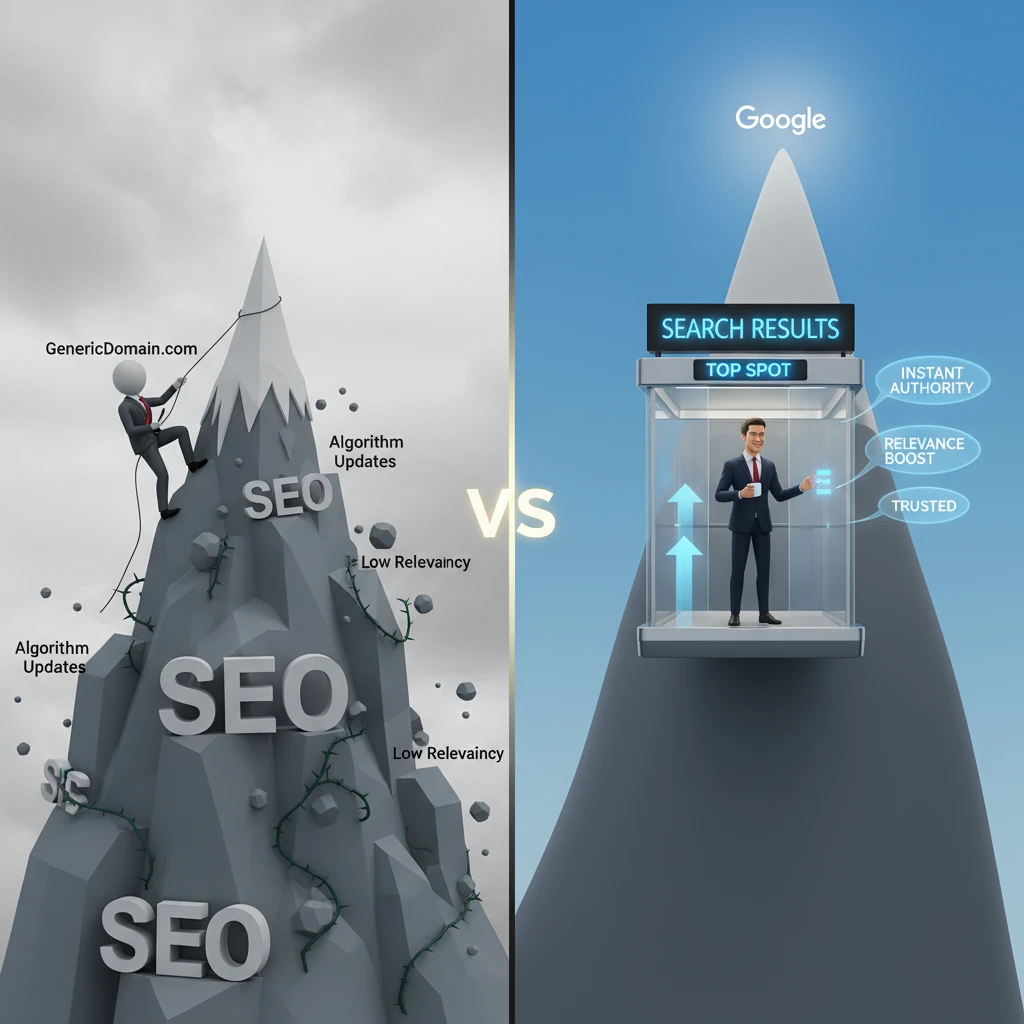
The short answer is yes, but with caveats. Years ago, owning an EMD was a “magic bullet” that could rank a site instantly. Google has since updated its algorithms to prevent low-quality sites from ranking solely based on their domain name. However, for local SEO, EMDs still provide a massive head start.
When a user searches for “Christchurch Electrician,” and your domain is ChristchurchElectrician.co.nz, the search engine sees a direct correlation between the query and the destination. Furthermore, the anchor text of inbound links will naturally contain your target keywords. If a directory links to your website using your URL, they are inadvertently boosting your keyword ranking.
However, an EMD must be backed by high-quality content. A premium EMD with thin content will be penalized. But a premium EMD with excellent content is a powerhouse that is incredibly difficult for competitors to unseat. It signals to users immediately what the website is about, increasing the Click-Through Rate (CTR) from search results, which is itself a ranking factor.
Should you choose a Brandable or Descriptive domain?
When identifying premium assets, you will generally encounter two distinct categories: Brandable and Descriptive. Understanding the difference is crucial for aligning the domain with your business strategy.
The Descriptive Path
Descriptive domains explain exactly what you do. Examples include Loans.co.nz or UsedCars.co.nz. The value here lies in immediate recognition and type-in traffic. These domains require less marketing spend to explain the business proposition because the name does the heavy lifting. They are fantastic for lead generation businesses or category killers.
The Brandable Path
Brandable domains are unique, made-up words, or words used out of context (e.g., Apple, Amazon, Trademe). These domains do not inherently describe the service, but they offer a blank canvas for building a unique identity. A premium brandable domain is usually short (under 6 letters), phonetic, and evokes a feeling (e.g., speed, trust, innovation). While they require more initial marketing to establish meaning, they offer greater protection from trademark infringement and allow for pivoting into different industries without changing the name.
For a premium portfolio, a mix is often healthy. However, for a specific business launch, the choice depends on the budget. Descriptive domains are expensive to acquire but cheaper to market. Brandable domains are cheaper to acquire (usually) but more expensive to market.
How to check domain authority and backlinks?
Not all “premium” domains are clean. Before investing thousands into a domain, rigorous due diligence is required to ensure you aren’t buying a “burned” asset. A domain might look great on the surface but could have a history of spam, penalties, or toxic backlinks that will hinder future growth.
To evaluate the technical health of a premium domain, you must look at its backlink profile and Domain Authority (DA). Tools like Ahrefs, Moz, or Majestic are industry standards for this analysis.

Key Metrics to Analyze:
- Domain Authority (DA) / Domain Rating (DR): A score from 0-100 predicting how well a website will rank. A higher score generally indicates a more valuable asset, provided the score is genuine.
- Backlink Profile: Look at who is linking to the domain. Are they reputable NZ businesses and news sites? Or are they low-quality link farms from overseas? A premium domain should have a “clean” profile.
- Spam Score: Check for toxic links. If the domain was previously used for gambling, adult content, or scams, it may be blacklisted by Google.
- Archive History: Use the Wayback Machine (Internet Archive) to see what content used to exist on the domain. This visual history can reveal if the domain was dropped or used for nefarious purposes in the past.
In the New Zealand brokerage market, a true premium domain comes with a clean bill of health. If a domain has high authority but a toxic history, it is not a premium asset—it is a rehabilitation project.
Frequently Asked Questions
What is the difference between a premium domain and a standard domain?
A standard domain is typically a new registration with no history or specific keyword value, costing a standard registration fee. A premium domain is a pre-owned or high-demand asset that commands a higher price due to its shortness, keyword relevance, age, brandability, or commercial potential.
How much should I pay for a premium .co.nz domain?
Valuation varies wildly based on the quality of the name. A solid 3-word local domain might sell for $500-$2,000 NZD, while a category-defining keyword domain (e.g., Property.co.nz) or a 3-letter acronym could fetch anywhere from $10,000 to six figures depending on the market demand.
Are .com domains better than .co.nz for New Zealand businesses?
For businesses operating strictly within New Zealand, .co.nz is superior due to local consumer trust and local search ranking benefits. However, if you have global aspirations, securing the .com is essential to prevent international confusion.
Can I lose a premium domain if I don’t use it?
Generally, no. As long as you pay the renewal fees, the domain is yours. However, trademark laws still apply. You cannot hold a domain that infringes on a registered trademark in bad faith (cybersquatting), as this can be challenged via the Domain Name Commission.
What is a “parked” domain?
A parked domain is a registered domain name that is not connected to a service like a website or email hosting. Investors often “park” premium domains with a landing page displaying ads or a “For Sale” sign to monetize traffic while waiting for a buyer.
How do I buy a premium domain that is already taken?
You will need to use a domain broker or reach out to the owner directly. You can find owner details via a WHOIS lookup (if public) or use a brokerage service to negotiate the acquisition anonymously and securely.
