

Expired Domain Strategy
An expired domains NZ list is a comprehensive database of New Zealand-specific web addresses (.co.nz, .nz, .org.nz) that have not been renewed by their previous owners and are available for re-registration. Digital investors and SEO professionals utilize these lists to acquire assets with pre-existing authority, backlink profiles, and traffic history to accelerate search engine ranking performance.
In the competitive landscape of New Zealand digital marketing, starting a website from scratch is akin to building a retail store in the middle of a desert. You have no foot traffic, no reputation, and no roads leading to your door. This is where the strategic acquisition of expired domains comes into play. By leveraging a high-quality expired domains NZ list, businesses can inherit the digital equity built by previous owners, bypassing the “sandbox” period often associated with new domains.
Whether you are a domain broker looking to flip assets for profit or an SEO strategist aiming to bolster a client’s backlink profile via 301 redirects, understanding the nuances of the .nz registry and the drop-catching ecosystem is critical. This guide provides a commercial-grade analysis of how to identify, vet, and capture high-value expired domains in the New Zealand market.
How the Drop Catch Process Works in NZ
To successfully secure a domain from an expired domains NZ list, one must first understand the lifecycle of a domain name as dictated by the Domain Name Commission (DNC) in New Zealand. Unlike generic top-level domains (gTLDs) like .com, the .nz country code top-level domain (ccTLD) follows a specific timeline that dictates exactly when a name becomes available to the public.
The Lifecycle Stages
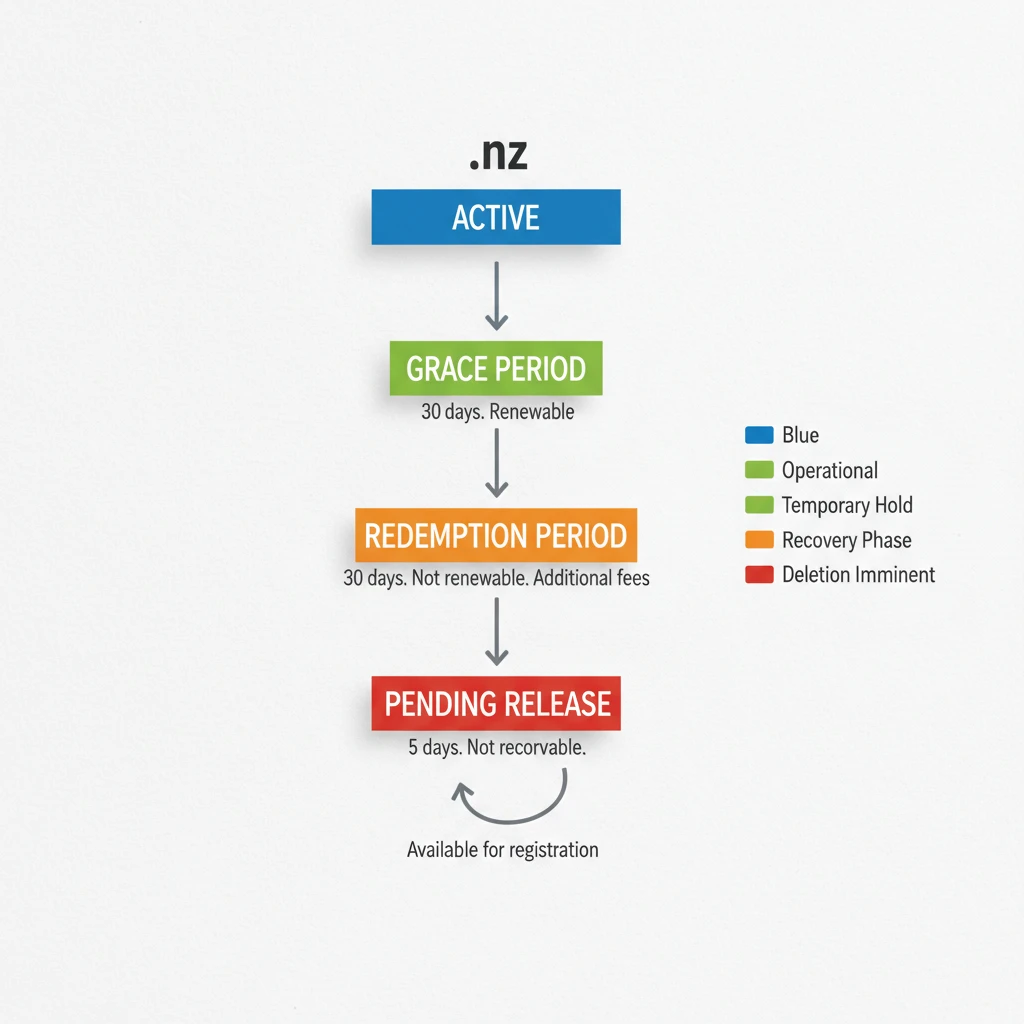
The process generally follows these stages once a registrant fails to renew:
- Active Status: The domain is live. If not renewed by the expiry date, it transitions to the next phase.
- Grace Period (0-5 Days): Immediately after expiry, the domain may temporarily stop resolving (website goes down), but the original owner can still renew it at the standard price.
- Redemption Period (90 Days): This is the critical holding phase. The domain is not active, but it is not yet available to the public. The original registrant has the exclusive right to restore the domain, often for a higher fee. This period is significantly longer for .nz domains compared to many other TLDs, requiring patience from investors.
- Pending Release (5 Days): Once the redemption period concludes without renewal, the domain enters a ‘pending release’ state. It is at the end of this period that the domain is “dropped” and becomes available for registration on a first-come, first-served basis—or captured by a drop-catching service.
Understanding this 90-day lag is vital. If you spot a valuable domain expiring today, it will not appear on a purchasable expired domains NZ list for roughly three months. Professional brokers maintain calendars to track these dates precisely.
Best Tools for Monitoring Expiring Domains
You cannot manually check thousands of domains daily. To scale your acquisition strategy, you need enterprise-level tools that aggregate data and provide an expired domains NZ list that can be filtered by metrics. Here are the industry standards for the New Zealand market.
ExpiredDomains.net
This is widely considered the gold standard for free aggregation. It allows users to filter specifically for .nz, .co.nz, .org.nz, and .net.nz extensions. Advanced filters allow you to sort by Majestic Trust Flow, citation flow, and the number of backlinks. For a commercial broker, setting up daily alerts on this platform is mandatory.
DomCop
For those willing to invest in premium software, DomCop offers superior metrics integration. It pulls data from Moz (DA/PA), Majestic (TF/CF), and Ahrefs (DR) directly into the dashboard. This saves time by allowing you to vet the SEO value of a domain without leaving the list view. It is particularly effective at identifying domains that are about to drop in the next 24 hours.
SpamZilla
SpamZilla is unique because it focuses heavily on the “cleanliness” of the domain. It provides a proprietary “SpamZilla Score” that indicates how likely a domain is to have been used for spam in the past. When dealing with an expired domains NZ list, filtering out toxic assets is just as important as finding high-authority ones.

Evaluating the SEO Value of an Expired Domain
Not all domains on an expired domains NZ list are worth acquiring. In fact, 90% are likely “junk” domains with no value or, worse, negative value. To identify the gems, you must conduct a rigorous due diligence process focusing on three core pillars: Authority, Relevance, and History.
1. Backlink Profile Analysis
The primary value of an expired domain lies in its inbound links. Use tools like Ahrefs or Semrush to analyze the backlink profile. You are looking for:
- Contextual Links: Links from relevant news sites (e.g., NZ Herald, Stuff.co.nz), educational institutions (.ac.nz), or government bodies (.govt.nz) carry immense weight in local SEO.
- DoFollow vs. NoFollow: A healthy mix is natural, but you want a strong percentage of DoFollow links to pass “link juice.”
- Anchor Text Ratio: Avoid domains with over-optimized anchor text (e.g., 500 links saying exactly “cheap loans NZ”). This is a footprint of previous spamming.
2. Historical Relevance (The Wayback Machine)
Never buy a domain without checking Archive.org. You need to know what the website used to be. If you are building a site for a New Zealand plumbing company, an expired domain that used to be a plumbing site is gold. If that same domain was repurposed three years ago to sell counterfeit sneakers or adult content, it is toxic. Ensure the history is consistent and clean.
3. Domain Authority metrics
While third-party metrics like Domain Authority (Moz) and Domain Rating (Ahrefs) are not official Google metrics, they serve as excellent proxies for value. A .co.nz domain with a DR of 30+ is a significant asset in the New Zealand market, where competition is generally lower than in the US.

Risks: Penalized Domains and Trademark Issues
High-reward strategies always come with risks. In the domain brokerage niche, the two biggest threats are Google penalties and legal trademark disputes.
Identifying Penalized Domains
If a domain has an impressive backlink profile but does not rank for its own brand name or has zero traffic despite having content, it may be penalized. A “Manual Action” from Google stays with the domain even after it expires. While some penalties can be lifted through a reconsideration request, it is a time-consuming process that delays ROI. Check the index status: type site:example.co.nz into Google. If nothing appears, the domain is likely de-indexed and should be avoided.
Trademark Infringement in NZ
Just because a domain is on an expired domains NZ list does not mean you have the legal right to use it. If the domain name contains a trademarked term (e.g., “FordCarParts.co.nz”), you risk losing the domain via a dispute resolution process.
In New Zealand, the Intellectual Property Office of New Zealand (IPONZ) handles trademarks. Before purchasing a premium domain, run a search on the IPONZ database. Additionally, familiarize yourself with the DNC’s Dispute Resolution Service (DRS). If a complainant can prove they have rights to the name and that your registration is “unfair,” the domain can be forcibly transferred to them.
Using Backorder Services Effectively
Valuable domains rarely stay available long enough for you to register them manually at a standard registrar. They are “caught” milliseconds after they drop by automated scripts. To compete, you must use backorder services (also known as drop catchers).
How Drop Catching Works
A drop catcher is a registrar with specialized software designed to send registration requests the microsecond a domain is released by the registry. If multiple users backorder the same domain, it typically goes to a private auction between those users.
Top NZ Drop Catchers
For .nz domains, international giants like DropCatch.com or SnapNames are often less effective than local specialists or platforms that have specific accreditation with the .nz registry. However, Pool.com and others do compete in this space. It is often a strategy of probability: placing backorders on multiple platforms increases your success rate. Note that you usually only pay if the service successfully catches the domain for you.

Developing a Commercial Acquisition Strategy
To turn an expired domains NZ list into a revenue stream, you need a clear exit strategy. There are three main commercial avenues:
1. The 301 Redirect Strategy
This involves buying a relevant expired domain and permanently redirecting it to a “money site” to pass on the link authority. This is a common SEO tactic. For example, a Christchurch dental practice might buy an expired domain of a retired local dentist to capture their referral traffic and authority.
2. The Private Blog Network (PBN)
While risky and frowned upon by Google, PBNs remain a reality in high-stakes SEO. This involves rebuilding a site on the expired domain to host content that links out to client sites. This requires significant management overhead to avoid footprints.
3. Domain Flipping
This is the practice of acquiring the domain, cleaning it up, perhaps putting a “For Sale” landing page on it, and selling it to a business that needs that specific name. In New Zealand, generic keywords (e.g., “AucklandPlumber.co.nz”) can command high prices due to their inherent branding value.
Successfully navigating the expired domain market in New Zealand requires a blend of technical SEO knowledge, legal awareness regarding trademarks, and the speed to execute acquisitions. By utilizing the tools and strategies outlined above, you can transform a simple list of expired names into a portfolio of high-value digital assets.
People Also Ask
Where can I find a list of expired NZ domains?
You can find lists of expired NZ domains on aggregator sites like ExpiredDomains.net, DomCop, and SpamZilla. These platforms allow you to filter by country code extensions like .co.nz and .nz, and sort by metrics such as backlinks and domain authority.
How long is the redemption period for .nz domains?
The redemption period for .nz domains is 90 days. During this time, the domain is inactive, but the original owner can still restore it. After this 90-day period, the domain enters a 5-day pending release status before becoming available to the public.
Are expired domains good for SEO?
Yes, expired domains can be excellent for SEO if they have a clean history and a strong backlink profile. They allow new websites to inherit existing authority (Link Juice), which can help them rank faster than a brand new domain with no history.
What is the difference between a dropped domain and an expired domain?
An expired domain is one that has not been renewed but may still be in the grace or redemption period. A dropped domain has completed the full expiration cycle and has been released by the registry, making it available for anyone to register immediately.
How much does it cost to buy an expired domain in NZ?
If you register a dropped domain manually, it costs the standard registration fee (usually $20-$40 NZD). However, if you use a backorder service or buy via auction, popular domains can sell for hundreds or even thousands of dollars depending on their SEO value and name quality.
Can I get penalized for using expired domains?
Yes, if the expired domain was previously used for spam, illegal activities, or has a Google Manual Action against it, those penalties can transfer to your new site. It is crucial to vet the domain’s history using Archive.org and check for toxic backlinks before purchasing.
