

New Zealand domain market intelligence involves the systematic aggregation and analysis of data regarding .nz digital assets, including registration trends, secondary market sales, SEO valuation metrics, and keyword liquidity. This intelligence empowers investors, corporations, and startups to make data-driven decisions regarding digital asset acquisition, brand protection, and portfolio management within the New Zealand digital economy.
In the rapidly evolving landscape of the South Pacific’s digital economy, access to precise data is the dividing line between speculative gambling and strategic investment. New Zealand’s digital asset market, anchored by the robust .nz country code Top-Level Domain (ccTLD), represents a significant sector of the nation’s intangible capital. Whether for mergers and acquisitions, brand defense, or pure-play digital real estate investing, understanding the nuances of this market requires a sophisticated approach akin to a financial terminal for equities.
Overview of the NZ Digital Asset Landscape
The New Zealand digital asset landscape is characterized by high trust, stability, and a strong preference for local localization. Unlike generic top-level domains (gTLDs) such as .com or .net, the .nz namespace carries a specific geopolitical weight that influences consumer behavior and search engine ranking algorithms within the region. For businesses operating in or targeting New Zealand, holding the correct digital assets is not merely an IT requirement; it is a fundamental component of intellectual property.
The market is primarily overseen by the Domain Name Commission (DNC), which regulates the .nz space. This regulation ensures a level of integrity and dispute resolution that makes the asset class attractive for long-term holding. However, the market is bifurcated into two distinct categories: the primary market (new registrations) and the secondary market (aftermarket sales of premium names). True market intelligence lies in deciphering the secondary market, where high-value, generic, and short-character domains trade for significant sums, often privately.

The Hierarchy of NZ Domains
Understanding the value chain requires recognizing the hierarchy within the local namespace. Historically, .co.nz was the standard for commercial entities, mirroring the .co.uk structure. However, the introduction of the shorter, second-level .nz extension created a shift in valuation dynamics. Market intelligence data suggests that while .co.nz retains immense legacy trust and corporate authority, the shorter .nz is gaining traction for modern startups and branding efficiency. A comprehensive digital asset terminal tracks the liquidity and pricing spread between these two extensions to identify arbitrage opportunities.
Access to Live Market Data and Valuation Tools
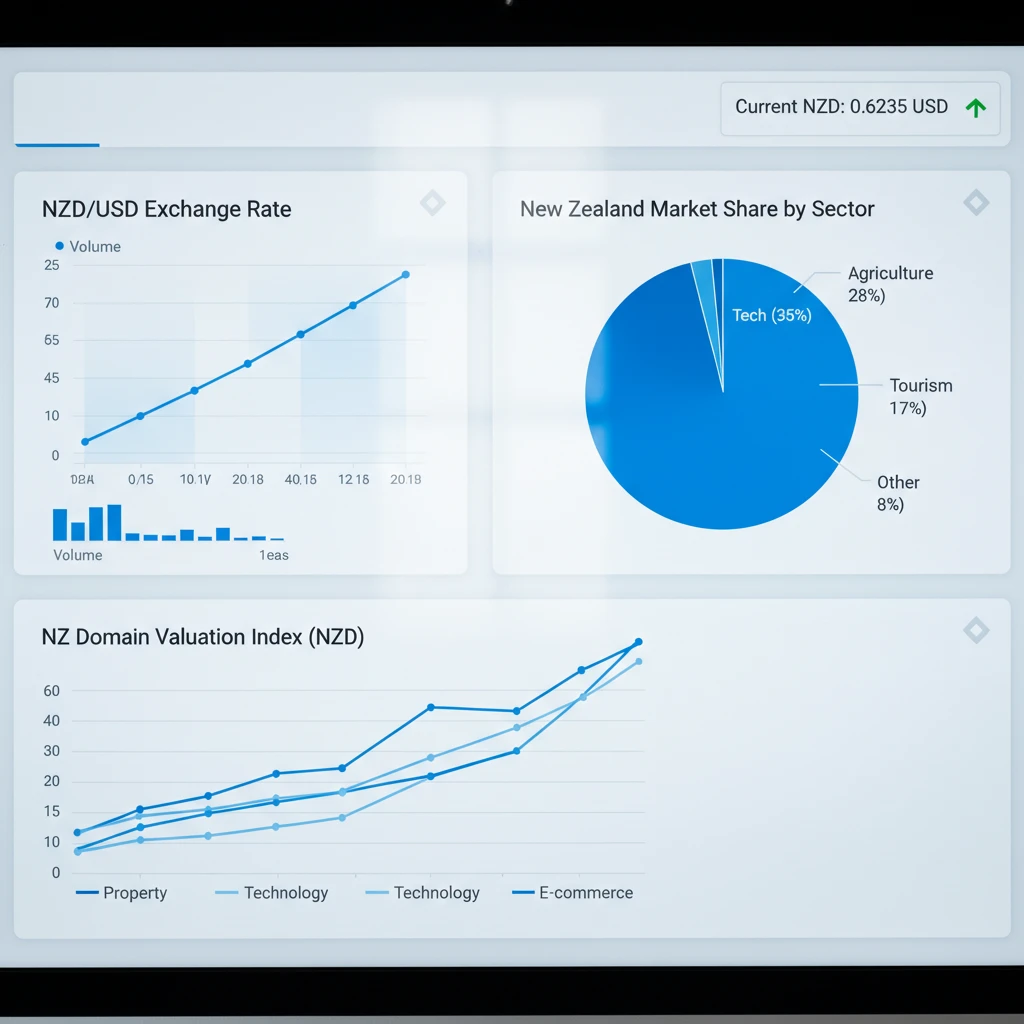
In the realm of digital real estate, information asymmetry is the primary risk factor. A Digital Asset Terminal focused on New Zealand provides the requisite telemetry to assess the fair market value (FMV) of a domain name or digital business. Valuation is not a static number; it is a dynamic calculation based on multiple liquidity metrics.
Real-Time Valuation Metrics
Professional valuation tools utilize a composite index to determine price. Key metrics include:
- Keyword Search Volume: Data derived from NZ-specific search queries (Google.co.nz) to determine the organic traffic potential of the exact match domain (EMD).
- Cost Per Click (CPC): The advertising value of the keywords contained in the domain. High CPC in sectors like insurance, finance, or real estate in New Zealand drives up the asset value.
- Backlink Profile: For aged domains, the quantity and quality of inbound links from other authoritative NZ sites (government, education, media) significantly impact value.
- Comparable Sales (Comps): Historical sales data of similar length and industry domains within the .nz namespace.
Analyzing Search Volume and Keyword Trends
Market intelligence goes beyond current value; it predicts future value based on search trends. For instance, tracking the rise in search volume for terms related to “fintech NZ” or “agritech solutions” allows investors to acquire relevant digital assets before the sector matures. Advanced terminals integrate API feeds from major SEO platforms to overlay search trend lines against domain availability and auction pricing.
The Role of Type-In Traffic
One of the most elusive metrics in domain intelligence is “type-in traffic”—users navigating directly to a website by typing the name into the browser bar, bypassing search engines entirely. This traffic is highly qualified and converts at a higher rate. Intelligence platforms use DNS traffic analysis (where available) or extrapolation based on linguistic probability to estimate this value for premium generic names (e.g., loans.co.nz or hotels.co.nz).
Gateway to Premium Leasing and Financing Services
As the valuation of premium .nz domains rises, the market has innovated to provide access through financial structuring similar to physical real estate. High-value assets, which can command prices in the five or six-figure range, are often out of reach for bootstrapping startups. This has led to the emergence of domain leasing and financing ecosystems.
Domain Leasing Models
Leasing allows a business to operate on a category-defining domain name for a monthly fee, with or without an option to purchase. This model transforms a large capital expenditure (CapEx) into a manageable operating expenditure (OpEx). Market intelligence platforms facilitate these transactions by acting as the clearinghouse, ensuring that DNS control is securely managed and that the lessee receives the SEO benefits during the lease term. Common structures include:
- Straight Lease: Long-term rental of the identity.
- Lease-to-Own: A portion of the monthly payment contributes to the principal purchase price, typically over 2 to 5 years.
- Equity Lease: Trading domain usage for equity in the startup entity.
Financing High-Value Digital Assets
For acquisitions, specialized financing is becoming a critical component of the NZ domain market. Because traditional NZ banks often struggle to collateralize intangible digital assets, specialized lenders and vendor-financing models fill the gap. Intelligence terminals provide the risk assessment data needed for these underwriters, validating the asset’s liquidity and historical stability to approve financing terms.

Latest Insights for M&A and Startup Acquisition
Mergers and acquisitions in the digital age are rarely just about acquiring customers or staff; they are about acquiring digital footprints. For NZ companies looking to expand or consolidate, market intelligence provides the due diligence framework necessary to evaluate target acquisitions.
Digital Due Diligence
When acquiring a New Zealand startup, the value of their primary domain and associated digital assets is often a significant portion of the deal. Intelligence reports analyze:
- Domain Portfolio Health: Does the target company own the defensive typos and extensions (e.g., owning both .co.nz and .nz)?
- Trademark Conflicts: Automated cross-referencing of domain names against the IPONZ (Intellectual Property Office of New Zealand) database to identify potential infringement risks.
- Traffic Source Audits: Verifying that the traffic claims made by the seller are backed by organic search data rather than paid bot traffic.
Identifying Undervalued Assets
A sophisticated digital asset terminal allows investors to scan the market for undervalued assets. These might be domains owned by defunct companies that are about to expire, or assets that have high authority but poor content (fixer-uppers). In the NZ market, buying a domain with strong existing backlinks from local news media can provide a massive SEO shortcut for a new venture. This strategy, known as “acquisition for redirection” or “site rehabilitation,” relies entirely on deep historical data.
Strategic Implementation of Domain Intelligence
Accessing data is only the first step; implementation is where value is realized. New Zealand businesses utilize this intelligence to construct defensive moats around their brands and offensive strategies to capture market share.
Brand Protection and Defensive Registration
Corporate domain management is a defensive necessity. Market intelligence tools alert brand owners when third parties register domains that are confusingly similar to their trademarks (cybersquatting). In New Zealand, rapid detection allows for swift action via the Dispute Resolution Service (DRS). Furthermore, intelligence data helps companies decide which defensive domains are worth renewing and which can be dropped, optimizing portfolio costs.

The SEO Advantage
Ultimately, the primary driver of domain value is its ability to rank in search engines. New Zealand domain market intelligence integrates deeply with SEO strategy. By understanding the “keyword difficulty” of specific NZ niches, businesses can decide whether it is more cost-effective to spend $10,000 acquiring a premium keyword domain that ranks naturally, or to spend $50,000 over two years on SEO agencies trying to rank a mediocre brand name. The data almost always favors the acquisition of the premium asset for long-term ROI.
Future Trends in NZ Digital Assets
The future of the New Zealand domain market is heading toward greater liquidity and integration with Web3 technologies. While the .nz registry remains centralized, the principles of tokenization are beginning to influence how these assets are traded. We are observing a trend toward fractional ownership of high-value digital assets, allowing multiple investors to share the revenue generated by a premium domain. Additionally, the tightening of privacy laws and data sovereignty makes local hosting and local domains more critical for compliance, further driving up the value of the .nz asset class.
Frequently Asked Questions
What factors determine the value of a .nz domain name?
The value is determined by keyword search volume in New Zealand, the length of the name (shorter is better), the commercial potential (CPC) of the industry, brandability, and historical sales data of comparable domains.
Is .co.nz or .nz better for a New Zealand business?
Historically, .co.nz implies a commercial entity and has deep trust. However, .nz is shorter, more modern, and increasingly popular for startups. Ideally, a business should own both to protect their brand and capture all traffic.
How can I find out who owns a specific New Zealand domain?
You can use the WHOIS lookup tool provided by the Domain Name Commission (DNC). However, due to privacy laws, individual registrant details may be redacted unless the domain is registered to a trading business.
What is the process for leasing a premium domain?
Leasing involves a legal agreement where the lessee pays a monthly fee for the exclusive rights to use the domain. The technical DNS settings are pointed to the lessee’s server, while the lessor retains ownership until the lease term ends or a purchase option is exercised.
Can I buy a domain that is already taken?
Yes, this is the secondary market. You can attempt to purchase it by contacting the owner directly or using a domain broker service to negotiate on your behalf. You may also check if the domain is listed on aftermarket platforms.
Why is New Zealand domain market intelligence important for SEO?
It helps identify high-value keywords and domains that have existing authority (backlinks). Acquiring these assets can provide a significant head start in search rankings compared to registering a brand new, zero-history domain.
